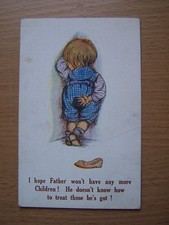
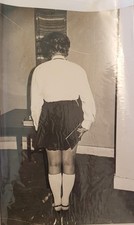
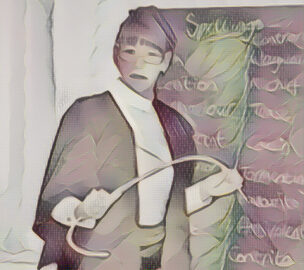
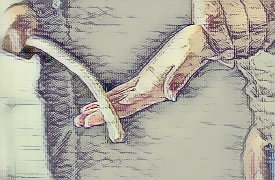
“‘In 1935 [in] Leighwood House, discipline here was enforced by the masters per medium of an extremely cruel horsewhip… bruising was seen by the school doctor and the whip barred. What was not known was that two little boys in the middle of the night entered the master’s study and hid the whip and so there was some trouble in locating it in order to have it destroyed. – perhaps this is a good example of self reliance. (I know who the other boy was but ain’t saying).’”
“Challenging traditions : a history of Melbourne Grammar” by Weston Bate and Helen Penrose.
Dr John Edward Bromby, Headmaster: “While Bromby did not express the same views as Morris about the problem with teaching and disciplining Australian boys, he meted out swift and severe punishments – so severe, in fact, as to draw complaints from parents. Bromby was challenged by the Council about the use of the ‘Black Hole’. They had received complaints by parents ‘of the confinement of boys in closets from which all light is excluded to which many parents strongly object and the Council are unanimous in desiring that punishments of this character be not inflicted’
. Bromby’s response was firm but perhaps open to compromise: ‘Lockups are made sufficiently dark to prevent reading, but light is not wholly excluded. Any modification can be made in these which the Council might think proper. Corporal punishment cannot be administered without my sanction. I will see that this regulation is rightly enforced.’
Bromby administered corporal punishment on average once a year, ‘but always pretty sharply’ according to the Annual Report of 1863. For example, he ‘had to flog a peppery boy today for having stabbed another with a pen knife. The offender pleaded in justification 1. that he had not done it, 2. that he did it in play, 3. that the other chap was throttling him with three handkerchiefs.’”
Reverend Andrew Wilson, Headmaster: “In spite of the apparent prosperity of the school in the late 1880s, the Council was not wholly satisfied with Wilson’s performance. It questioned his authority on disciplinary matters, as it had done with Bromby. There was no doubt that Wilson was a strong disciplinarian. He reported entire groups of boys for misdemeanours such as being late for breakfast, and being reported meant a Saturday detention of up to two hours. But in 1889 Council insisted, after a written complaint from other prefects, that Wilson explain to them why he thrashed a prefect for allegedly not kneeling during prayers:
Reverend Andrew Wilson, Headmaster: “In spite of the apparent prosperity of the school in the late 1880s, the Council was not wholly satisfied with Wilson’s performance. It questioned his authority on disciplinary matters, as it had done with Bromby. There was no doubt that Wilson was a strong disciplinarian. He reported entire groups of boys for misdemeanours such as being late for breakfast, and being reported meant a Saturday detention of up to two hours. But in 1889 Council insisted, after a written complaint from other prefects, that Wilson explain to them why he thrashed a prefect for allegedly not kneeling during prayers:
‘When school was reached Church, Dr Wilson [ordered three prefects to go to his study and] asked him why he did not kneel [and he] said he did not know; and immediately Dr Wilson said he would cane him, if he did not find out. Not receiving an immediate reply, Dr Wilson losing all control over himself seized a large cane and commenced belabouring [him] over the head and shoulders. [The prefect] in self-defence, opened the door and tried to escape. Dr Wilson pursued him till [he] fell, and struck him while on the ground. He then brought him back to the study [and] administered a severe thrashing.’’
The prefect’s father also complained, highlighting the inappropriate nature of the punishment, especially for a prefect, and criticized the entire prefect system. Wilson, however, made the prefect apologise, and indicated to the Council his disapproval of their intervention in a matter of school discipline that undermined his authority.”
Mr Bill “Mousey” McKean, Boardinghouse master: “Tony Trumble’s (OM 1950) hatred of school life – of sadistic hoodlum prefects, of compulsory sport and the tyrannical matron who ruled with the cane at the Healesville Evacuation School in 1942 – is leveled at McKean, who withdrew Trumble’s right to go home one weekend for being late to a meal: ‘
Weekends were heaven as I could escape back home for two whole days, and its loss was a disaster of monumental proportions to me. A far worse punishment than the cane could ever be… During that lost weekend I arrived late for afternoon tea and “Mousey” gated me again for the following weekend. If ever I was close to suicide it was then.’”
“A cornerstone of Melbourne Grammar’s identity was its discipline, but Old Melburnians are divided in their opinion of the benefits of corporal punishment as the disciplinary core of the school. Its use to enforce school rules and discourage general misbehaviour was, for the most part, accepted as part of growing up, but its use in the classroom as a substitute for good teaching did little to explain mistakes and misunderstandings:
‘I never understood how six strokes across the backside from a long cane of a sadistic master was helping me to understand geometry – a subject of which I had no prior comprehension.’ Some pupils far preferred the cane to the anticipation of a Saturday detention. Overall regimentation associated with Public School education before World War II provided benefits to some pupils who, from various backgrounds and for various reasons, felt that this was an appropriate way to provide discipline during their teenage years. For others this could not have been further from the truth: ‘Melbourne Grammar taught me a lifelong distaste of all-male institutionalised official regimentation and entrenched squareness.’”
Mr Joseph Richard Sutcliffe, Headmaster: “Perhaps not surprisingly, given this bad feeling, it was perhaps only a matter of time before the Council found an excuse to dismiss him. The headmaster was stripped of his control in one of the most dramatic incidents in the school’s history when the Council refused to support his decision to expel and punish pupils for their part in what became known as ‘The Dancing Class Incident’ at Merton Hall. Normally unremarkable events, dancing classes were run by Alan ‘Pansy’ Finlayson and his sister Janet at Merton Hall on Friday nights for separate senior and junior classes of boys and girls from both school.