In Scotland, the use of the belt in schools was an everyday occurrence with many beltings being given in virtually every school every day. It was not unusual for individual pupils to be belted more than once in a school day Whether the lack of any requirement to record corporal punishments was a factor, or whether the Scots had a history of more harsh school punishments than the English is open to debate, but either way we can be certain that the Scottish tawse was in use far more frequently than was the English cane.
Perhaps the English use of two levels of punishment was a factor. While in England the slipper (or gym shoe) was used for more minor offences, with the cane reserved for more serious breaches, while in Scotland the tawse was used for all manner of offences with the level of severity controlled by the weight of the application, type of tawse used or number of strokes given.
The only recorded evidence of the extent to which corporal punishment was administered in Scotland’s schools is when, for short periods, universities decided to carry out surveys to ascertain the extent to which the belt was being used in any given time period.
As I have mentioned on more than one occasion I learned more about the periodical mood cycles from the nuns’s behavior than I did from any biology book. The phases of the moon were like the faces of the nuns. Some had more craters than others but they were all lunatics.
I never looked at a calendar but knew by the successive blooming of the crocuses, tulips and so on just how close I was to freedom. The sunflowers would be twice my height and I would jump up and punch them for they meant back to school. The sunsets and sunrises were endpoints as were sure indicators as the streetlights.
Before you tell me that I need professional help, let me tell you I have gone that route. You talk about your problems and they call you a narcissist. I tell them to go look yourself in the mirror. They give their meanest clients jobs as debt collectors. You have to be crazy to go back again and again to see one of them.
For two people, the probability is 1/365. Three people represent three combinations of two people, so the probability is 1/365 + 1/365 + 1/365 = 1/122. Four people give 6 two-person combinations = 6/365 = 1/61.
In order to be probable, ie. have a probability of 1/2 or greater, we need a number whose combinations add up to 365/2 = 182. Twenty people give 190 two-person combinations, giving a probability that two of those twenty people share a birthday of just over 50%.
One possible theory for the unusual number of canings on the 22nd of the month could be that it was payday for the teachers, and they went to the pub for a quick celebration ( I know that happened in a few places I have worked ), and fuelled by alcohol they were much less reluctant to dish out a few canings.
As for the name Cane, I remember looking at Who’s Who in the school library to see if any famous headmasters were called Cane, and in fact there was one, though I think it was spelled Caine. There is also a current Australian Rugby International called James Slipper, though I don’t know if he has ever trained as a teacher.
Growing up Catholic in America. Had only I been more aware of the birds and the bees. Sister Mary Godzilla was too young to be going through menopause. I knew something about periods because I had an Encyclopedia Britannica before Wikipedia in the reference room in the library. They, if you recall, had Flagellation & the Flagellants: A History of the Rod by William M. Cooper. under lock and key.
Did that librarian 50 years ago know whether it was locked up for it may have been of antiquarian interests or for some other reason? Was she being kind or was she strumpet? I ask too many questions. No wonder I was always in so much trouble
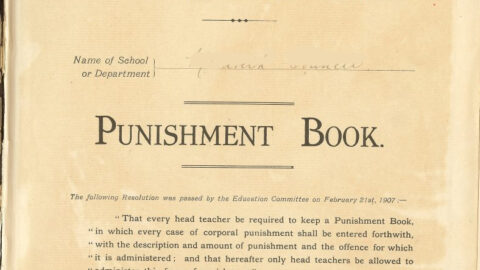
Such examples of punishment books I’ve seen in Australia, tend to fall into one of two categories – imported from Britain, or printed specifically for state education departments by whoever had the government printing contract for that state at the time – and independent and Catholic schools were allowed to purchase from the government printer as well.
When corporal punishment ended in state systems, presumably they stopped printing the books (although bureaucratic inertia being what it is, I wouldn’t guarantee that).
One interesting feature here in Victoria is that some schools – especially Catholic schools for some reason in my experience – often recorded corporal punishment in the ‘Accident Book’ – a similar register that was meant to be used to record any injury that occurred in a school. I’m not sure if it was just more convenient to have one book, or if it was some attempt to pretend things weren’t really happening, or what was going on.
I’d been planning on posting the following image at some stage in the near future – this seems a good place. It’s taken from a British teacher’s magazine of 1901, and is part of an article where a school inspector is giving advice to teachers:
I don’t know what it is about Birmingham and me, but I do keep coming in possession of punishment records from that LEA.
(It just keeps reminding me of the Sex Pistols song “Bodies”, which starts ”
She was a girl from Birmingham
I really liked that album, my parents did not
Here is a Birmingham school punishment book spaning 19 years from 1932 – 1951. I do not (yet) know the school, but it seemed a regular co-ed school. There are exactly 50 entries, and 50 unique pupil names, meaning I had no recidivism analysis to do, as it was nil. The pupil names have been redacted (and replaced with “boy” or “girl”) to keep my presentation in line with Birmingham’s privacy policies regarding student records, which says that pupil names cannot be released until 100 years have elapsed.
All incidents are caning, and on hands only. Punishment ranged from 1 to a maximum of 4 strokes, with 2 being by far the most common.
There are several interesting observations that come from this.
First: The method of punishment. I was once in possession of two punishment books from the Stewart Street School in Birmingham. Those books spanned 1892 to 1943, and again all incidents were for caning, and on the hands only. It would appear that Birmingham was one of the LEAs that adopted hand caning (rather than seat) and that this occurred even prior to the 1900’s. (in case you’re wondering, those have since been returned to the possession of the Birmingham archives)
Second: the frequency of punishment. 50 incidents spanning 19 school years is about 2 1/2 canings per year. This evidences the incredible amount of restraint in deploying CP at this school. I have seen other books (like The Catford Boy’s School, London) where the caning rate averaged 3 per day, not per year!
Third: sexism. being a co-ed school, I would assume the ratio of boys to girls would be pretty close to one to one. Yet, boys received 10 times the punishment rate of girls, or boys 92% and girls 8%. Whether intentional or not, once again there appeared to be discrimination based on sex in this aspect, and that is a typical observation.
Four: the types of offences punished. The top category in almost every set of records usually is general misbehaviour (disobedience, rudeness, insolence, stc.) and that category typically takes 30% to 40% of all offences. This school seemed to have a problem with children throwing stones as that was the top category, disobedience being second.
There was also a high proportion of “dirty behaviour”. All offenders were boys, and usually in the lavatory, so I’ll leave what the offence might entail to your imagination. The strangest offence was a one time “setting fire to clothing”. One can only hope no one was wearing them at the time!
What is glaringly absent is the smoking offence. This is something that typically ranks prominently in such records, so I am surprised to not have seen even one incident of it over 19 years. PS – the Capcha thing is driving me nuts, I hope this fifth attempt works
I assume it is a primary school. Even so the numbers seem very low by 1950s/1960s standards. There is no clear indication of the children’s ages or classes, except for possibly the second page and then there seems to be preponderance of class 1 and 2 (age 6-7) ??. All of the class teachers listed were women, understandable in the war years but surely less so in the Depression. This seems to indicate that maybe the male teachers did their own punishments, which may or may not have been recorded in a book.
I am pretty sure Birmingham’s state schools required record keeping of all instances of CP, and that this requirement began in 1892. The reason I say this is that the Stewart Street County Primary School (located in Ladywood, Birmingham) opened in 1873, however, from what I’ve seen, the records begin in 1892. Also, the fact that all books I’ve seen are in the same official format printed specifically for Birmingham “Birmingham School Board” or “City of Birmingham Education Committee” lends further evidence that it must have been a requirement to keep records. Otherwise, why go through the bother and expense to procure these?
This unknown school is certainly a primary. It is possible it was a very small school, perhaps one class for each grade from 1 to 6, so there may only have been 100 to 150 pupils enrolled. What is more likely is that several books exist, and so the data set is incomplete. The reason I say that is because the Stewart Street School had approx 1,000 pupils (boys & girls) divided into differing departments over time. Each department had it’s own punishment book so there are books for at least the following I’m aware of: Infants Dept, Boys Dept. Girls Dept, Senior Boys Dept, Junior Mixed Dept. and they span the same time frames as the various departments were in existence.
So it is quite possible that other books from different departments exist, covering the same time frame as the records above. I hope to be able to tell you more if the archives accommodate…
The extracts from the Birmingham punishment book are fascinating, but I wonder whether they give a misleading impression of the actual prevalence of corporal punishment in that school.
The reason for this conjecture (and it is, of course, a conjecture) comes from my own experience in primary school. My school was in a different part of the country — Willesden, in North-West London — but I was there in the period 1954–1961, not too long after the final page of the punishment book shown above. Corporal punishment was used when I was in the junior (rather than the infants) school, for the four years 1957–1961
I don’t believe that the cane was used very often in that school. Sometimes we would hear on the grapevine that someone had been given “four of the best”, it was usually four rather than six; but this didn’t happen very often. These formal canings, entered in the punishment book, were given by the senior master, and possibly also by the headmistress, though I don’t know for certain. I once accidentally saw such a caning, given in an empty classroom by the senior master, because I happened to be walking past the door (which had a glass panel) at the time; a boy was being caned on his hand.
I also once saw a boy being led from the headmistress’ office by the senior master; judging from his demeanour, he had been caned on his bottom. The school was mixed, but I do not believe that girls were caned. Very occasionally, though, a girl would be slippered by the headmistress; on one occasion she felt the need to announce this fact to the school at assembly.
A researcher looking through the punishment book for this school would therefore get the impression that CP was used only occasionally in this school.
But that was not the case, because nearly all of the teachers used classroom CP, and I have no recollection of a teacher ever making a note in a book after (or before) administering such a punishment. I suppose they might have done so after the end of the lesson, but somehow I doubt it. Although classroom CP was less severe than the “formal” version, it wasn’t a completely trivial affair, and was very much more prevalent.
There might have been half a dozen canings a year throughout the school, whereas the slipper must have been used half a dozen times in class during my first fortnight of junior school, and that was just one class out of eight in the school. (I admit that our teacher that term wielded the slipper more often than most.)
In terms of the atmosphere in the school, the widespread prevalence of classroom CP very much overshadowed the occasional use of formal, more severe, CP, but would not register in the historical records at all.
My father was deputy head and later headmaster of the school, and I had the opportunity to take a furtive peek at the Punishment Book on a couple of occasions.
The entries were similar in number and for reasons remarkably similar to those HH has shown. However, far more corporal punishments occurred in the classroom that were not recorded.
When I was a guest at the 75th anniversary of the school in the 1990s, I managed to get my hands on the Punishment Book once again and noted that my father’s successor, who took over in the mid-60s, caned significantly more often and with greater severity than before. By that time, the school was co-educational and I understand there was no longer any classroom corporal punishment. Perhaps minor classroom punishments acted as a good deterrent?
In the Junior School there was classroom CP all the way through, and quite a lot of it. Slipperings, rulerings and smackings for boys and girls. I don’t believe there were any punishment books involved at all. Teachers simply called miscreants to the front of the class, punished them, and continued the lesson. In theory probably children could have been sent to the Headmaster to be caned, but as far as I am aware no Junior School children were caned while I was there, and certainly we didn’t consider it as a possible outcome of naughtiness at that stage. Had any children been so dealt with I have no doubt that there would have been a punishment book entry. I understand that there was when he caned children from the Senior School, a fairly frequent event
I’m sure you are all completely correct. You were schooled in different LEA’s but I highly suspect this could have been the case here at this school as well. I have no evidence that suggests Birmingham categorically required <em>all</em> CP must be recorded. So, if either illicit and / or the standard in-situ classroom CP was meted, then yes, it would likely not have been recorded. It’s frequency may well have exceeded the recorded incidents by many multiples.
This has always raised the question for me: What’s the point of keeping records if they are selective, seriously incomplete and unrepresentative because of all the unrecorded in-situ CP?
For the reasons you state, and while it’s interesting to dissect such CP book numbers, I’ll be the first to admit that such typical records from England are unreliable to conduct a proper study on efficacy and recidivism. To do this, one needs to work from records within boards (LEAs) that explicitly mandated 100% of all CP be meted by a head in the office, witnessed and recorded, and where regulation stipulated any unauthorized CP (in the classroom) could lead to immediate dismissal of the educator. (My Toronto boards operated like this hence my continued campaign to access them for such purposes)
In comparison to your experiences, I can add when I was in elementary, it was yet another system altogether. 2-tiered in an unusual way. Classroom CP was the norm through grade 4 and on a couple of occassions I got a few smacks on the bottom myself. But these were relatively quite mild, more of a “snap out of it” than of the “can’t sit for a week” variety. But I did see some pretty fervent spankings with a thick ruler of the latter variety. From grade 5 onwards, all CP was hand strapping in the office, witnessed and recorded, and true to this, I never saw classroom CP after grade 4.
From the Catford Central School for Boys, London, England.
A Study and Analysis of Caning Entries from the Schools Punishment Book
Entries dated Feb. 20, 1953 through Feb. 27, 1956
One object of this study is to determine whether there were any statistically meaningful trends in how the practice was applied. Simply by perusing the pages, the punishments seemed rather random but indeed there was, at least to some degree, unwritten policy in how offenses were treated.
The punishment book contains 90 pages, with 594 boys caned in 1,710 separate incidents. The boys range in age from 11 to 16 years old. All punishments were executed by caning with a minimum of one stroke and a maximum of six strokes recorded per offense. These were applied to the seat 90% of the time and to the hands 10% of the time.
The period covered by this punishment book is 3.02 years. With a total of 1710 entries, this represents an average of 596 entries per year. Further, with approximately 180 school days per year, this represents an average of 3.1 canings for each school day in the period examined. One of the shortcomings of this data set is that is does not cover the entire school life of any boy, and therefore a complete recidivism study is not possible.
The 594 uniquely identifiable student names indicate that the boys who were caned were caned 2.9 times each on average. Of course, this figure is misleading as the vast majority of students were only caned once or twice in this period, with others being punished multiple times. This is shown in the punishment distribution chart. The average number of strokes given was 2.0.
There is another shortcoming with this data set: because I do not know the average enrollment figures for the school at the time, I cannot place the number of caned boys in context to the total number attending. For example: if the school had 1,000 enrollments, and 200 turnover per year, and straddles 4 school years, then unique attendance in the period was 1,800 boys. The 594 caned represent that roughly one-third of all boys in attendance during the period were caned for some offence.
The most-caned boys were as follows:
Boy1 had 24 incidents, 57 strokes applied, or 2.4 average strokes per incident
Boy2 also had 24 incidents, 72 strokes applied, or 3.0 average strokes per incident
Boy3 had 23 incidents, 41 strokes applied, or 1.8 average strokes per incident
The youngest boy on route to a record was an 11-year-old, who had already logged 13 incidents of 1 to 3 strokes, 26 strokes applied, or 2.0 average strokes per incident. This also means he was caned more than once per month in his first year. That is most concerning because this method (based on recidivism) was obviously not working, and likely causing unintended harm. So here’s a shining example where the root of the problem needed to be identified and other methods tried.
Of the 1710 entries, 178 (or 10%) were applied to the hands and 1532 (90%) were applied to the seat; therefore, it appears that the seat was preferred on a 9 to 1 basis.
The first observation is that the preference of caning the hands or the seat was not dependent on age. Within statistical error, it can be seen that all age ranges from 11 through 16 experienced roughly the same ratio, the seat being favored 85% to 95% depending on age, and 90% on average.
Further, there was no quantifiable factor (who did the caning or what the offense was) that convincingly lead to a preference of caning the hands or seat. It appears this was simply up to the discretion of the person meting out the punishment on those particular occasions. The one standout was this: More than 2 strokes on the hands were exceedingly rare and even when 2 were given, the notations that followed many times read “one on each hand”.
The second observation is that the severest punishments were applied only to the seat. There were 30 incidents where six strokes were given, and all were applied to the seat. (of the 30 data points, there was a one-off 5-stroke entry. Due to tabulation brevity, this was included in the 6-stroke data point.)
Other notes: several students could be identified as the same person even though spellings differed beyond the usual shortening of names (such as “Tony” for “Anthony”, etc.) and because age and classroom number was included with the entries. In tougher cases, the class number along with the other boys being punished alongside (guilty by association) were convincing clues in determining the same identities.
Table 2 provides insight as to how often boys of different ages were punished, and to what degree. It should be noted that the drop in data points for 16-year-olds is likely related to a decreased population of that age group – as they permanently left the school.
The data broken out by age shows several clear trends. First, it was most common to apply 2 strokes, and 2-stroke entries comprise 56% of all entries. 1 stroke was 24%, and the number of incidents where 3 or more strokes were applied declined dramatically as more strokes were given.
The majority of canings applied to 11-year-olds was 1 stroke (54%). Presumably, this was to send a message that misbehavior at this school would be corrected by caning; 1 stroke was in most cases enough to discourage repeated offenses requiring additional canings. The one notable exception to this was the 11-year-old mentioned earlier, caned on 13 occasions.
Table 2 provides insight as to how often boys of different ages were punished, and to what degree. It should be noted that the drop in data points for 16-year-olds is likely related to a decreased population of that age group – as they permanently left the school.
The data broken out by age shows several clear trends. First, it was most common to apply 2 strokes, and 2-stroke entries comprise 56% of all entries. 1 stroke was 24%, and the number of incidents where 3 or more strokes were applied declined dramatically as more strokes were given.
The majority of canings applied to 11-year-olds was 1 stroke (54%). Presumably, this was to send a message that misbehavior at this school would be corrected by caning; 1 stroke was in most cases enough to discourage repeated offenses requiring additional canings. The one notable exception to this was the 11-year-old mentioned earlier, caned on 13 occasions.
The table bottom right shows a clear trend: as boys were older, they were afforded progressively higher strokes per incident. Only 46% of 11-year-olds received 2 or more strokes, and this value rose consistently to 16-year-olds, who received 2 or more strokes 94% of the time. The same trend can be seen in percentages of 3+, and 4+ strokes per age.
Notice also that serious offences only began to be met with 4 or 6 strokes at the age of 13 or higher. From 14, any incidence of truancy, for example, brought 6 strokes, whereas the few examples of this for younger boys attracted more lenient treatment.
Table 3 illustrates that the vast majority of boys met with canings on only one or two occasions. In fact, 45% of boys were only caned once and 65% once or twice with 3/4 of the boys never caned more than three times maximum.
The reasons of the above observation is obviously up to contentious debate, however; it would appear that the punishment was in most cases a sufficient deterrent to prevent repeat performances for the vast majority.
It can also be seen that 1 in 20 caned boys (5%) represented the great minority who were caned 9 or more times. Only 3 students (0.5% of all caned boys) were inflicted with 20 or more canings.
Further, it can be shown that serious offences, such as truancy, were concentrated into only a few repeat offenders. In these cases, the canings provided a short-term deterrent, but not a permanent one. I would note from unrelated anecdotal observations, that 6 well-planted strokes would leave the offender’s seat bruised for up to two weeks. It is coincidental to note that in the serial-offender cases, the minimum time span between repeated offences roughly reflected the anticipated time required for their bottom to have healed from the previous caning. The only one exception to this was a boy (14) receiving 6 for truancy on 18 Nov 1954 and then another 6 for truancy only for days later, 22 Nov.
Other observations:
The vast majority of entries are for an individual or small group participating in the same offence. However, there are a few instances where a larger proportion of a particular class was caned, usually for failure to do assigned work or insufficient effort in the same. One example had nine 15 year old students, all from the same room, receiving 2 each on the seat for exactly this type of reason. I have not noted any entry caning an entire classroom.
There is another apparent trend. This did not necessarily show in the data but became apparent in the compilation of it. If a boy had never been caned before, he tended to receive leniency on the first offence, and once he was already known to have be caned previously, there was a bias to increase the number of strokes. Good examples are 11 and 12-year-olds who got 1 the first time but 2, sometimes more, on subsequent visits.
Sometimes caning for an offence does not immediately stop that behaviour and it needs to be revisited with greater severity. A good example of this was two (14 year old) boys receiving 3 strokes for copying work. They repeated this offence only 2 days later and both were caned with 4 strokes each this time. The activity appeared to cease after the second caning. I assume the third time it would be 5 or 6.
All the offences listed are very much what would be expected: disobedience, failure to do (or poorly done) assignments, truancy, bullying, vandalism, talking (in assembly), smoking, climbing various structures or being in prohibited areas at times. Of the more peculiar entries, a (12 year old) boy received 3 on the seat for “Disgusting game in the lavatory”.
Conclusions:
It appears that, although the aggregate amount of caning was quite high at 3 per average day, the typical boy (65%) only experienced one or two canings which was most usually 2 strokes given to the seat. So, while on the surface the caning rate appears quite excessive, when distilling the distribution down, it is still robust but not as egregious as it initially appears. Having said that there should have been a serious look into the cases where boys were caned more than 20 times within three years. That’s a red flag to me because the canings were obviously not modifying behavior in those cases and perhaps something else was going on here
The number of strokes given was primarily dependent on the age of the student, and then secondarily dependent on the nature of the offense, and thirdly dependent on whether the boy was a first-time offender or not. There are statistically significant patterns in the data to illustrate these three considerations. Truancy was considered the most serious offense and usually drew the maximum 6 strokes. Therefore, it can be concluded that there was some predisposed thought given to how many strokes would be applied in a given situation. (NB: I didn’t write all this last night, I have redacted this from an original unpublished study I once performed).