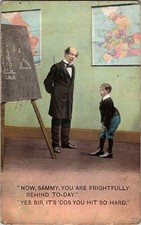
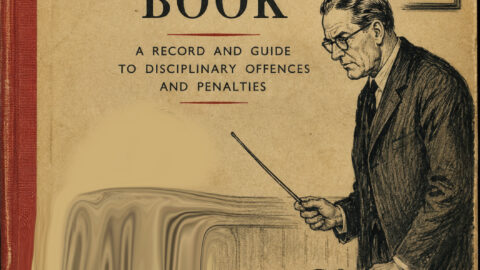
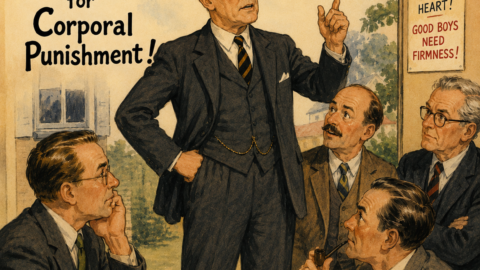
There was a time, not so very long ago, when school discipline was measured not merely by detentions or stern words, but by the sting of cane, paddle or strap. In classrooms from Britain to America, corporal punishment was regarded as an accepted part of education. Most pupils hoped never to experience it, although a surprising few admitted to being curious enough to discover what it felt like.
My own first encounter with the cane came not because of one spectacular act of rebellion, but because of what the school described as my “general attitude.”
There was no single offence worthy of severe punishment. Instead, it was the accumulation of countless minor misdemeanours. I regularly cut across the quadrangle lawn instead of keeping to the proper pathways on the way to chapel. Registration often found me arriving just after everyone else had settled. Lessons would begin before I finally appeared at the classroom door, never late enough to attract punishment every time, but frequently enough for masters to conclude I considered their lessons less interesting than the conversations I had reluctantly abandoned outside.
Then there was the habit of answering back. I was never openly insolent, but I possessed an unfortunate talent for producing clever replies which tested a master’s patience just a little further than was wise.
Looking back, I suppose I learned a simple lesson. Poke a sleeping dog often enough and eventually it will bite.
By the time I stood before the headmaster’s desk, my reputation had already been established. The cane was administered not for one offence but for the pattern of behaviour that suggested I was forever probing the limits of authority.
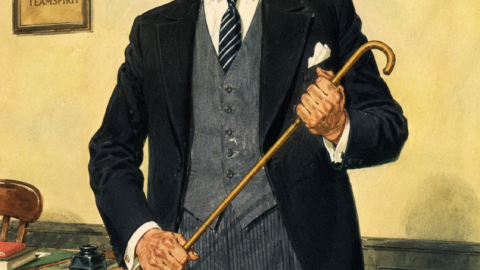
The ceremony surrounding the punishment was every bit as memorable as the strokes themselves. The offender was summoned into the headmaster’s study, where silence hung heavily in the room. The rattan cane rested in plain view, an unmistakable symbol of authority. Formal words were spoken, the offence briefly rehearsed, and then came the familiar command to bend over.
The anticipation was almost worse than the punishment itself.
Each stroke landed with a sharp crack that echoed around the room. A fierce burning pain spread instantly across the seat of the trousers, followed by an intense throbbing which lingered long after the caning had ended. There was little dignity in the experience. One returned to class determined to conceal the discomfort, though every movement served as a painful reminder of the encounter.
It was an experience few deliberately wished to repeat.
Across the Atlantic, however, punishment took a rather different form.
A German exchange student who spent a year at a Texas high school during the late 1980s found himself astonished by what he witnessed. In Germany, school corporal punishment had disappeared after the Second World War, making the American practice seem almost like a relic from another age.
Every teacher possessed a wooden paddle, usually hanging openly on the classroom wall. Hardly a day passed without the unmistakable sound of someone receiving a paddling in the corridor.
Classmates assured him that it looked worse than it felt.
Curiosity eventually got the better of him.
His English teacher, Mrs Taylor, was a pleasant woman in her forties with the appearance of an old-fashioned schoolmistress. One afternoon the class ignored repeated requests for silence while working on an assignment. After several warnings she calmly announced that the next pupil to speak would receive two swats with the paddle.
Almost without thinking, he spoke.
Mrs Taylor stared at him in disbelief before quietly collecting the paddle from its place on the wall. Escorting him into the hallway, she summoned another teacher to witness the punishment, following school regulations.
He was instructed to bend over.
The paddle descended with considerable force.
The first blow came as a tremendous shock, producing an explosive crack and a deep, spreading ache across both buttocks. Before there was time to recover, the second stroke followed immediately, intensifying the pain until it became almost impossible to stand comfortably.
His classmates had been mistaken.
It certainly hurt.
British schools, meanwhile, possessed their own traditions.
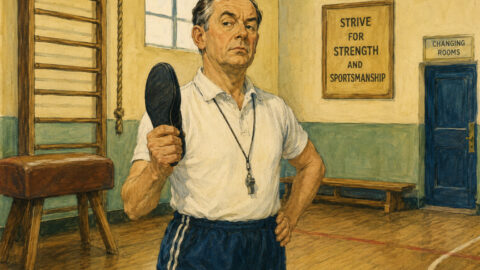
One former pupil remembers the woodwork master dealing with latecomers by administering a couple of sharp whacks with a specially selected block of wood. The instrument varied according to age: first-form boys received a comparatively small block, while senior pupils faced something altogether more intimidating.
The punishment was entirely unofficial. No record appeared on school reports, sparing parents from learning of their son’s misdemeanours.
Indeed, some boys confessed that the temporary warmth and tingling left by the blows was preferable to the far greater punishment that awaited them at home should a bad report arrive. It was enough, on occasion, to encourage a little deliberate dawdling.
There were limits, however.
No one deliberately crossed the headmaster’s path.
His cane represented a very different order of punishment altogether.
Woodwork teachers seemed an unusual breed. Another recalls his own master as normally gentle and mild-mannered, except where his precious glue pot was concerned. The pot simmered constantly in the workshop, and mischievous boys delighted in secretly dropping scraps of wood, metal or other objects into it, rendering the glue useless.
When the unfortunate master discovered the ruined mixture, his despair was almost painful to witness.
He rarely issued detentions, preferring stern lectures instead.
Yet everyone understood that should a member of staff actually witness the sabotage, the offender would almost certainly find himself before the headmaster, where the familiar phrase “six of the best” awaited him.
Did boys deliberately invite corporal punishment?
Undoubtedly a few existed who seemed almost to challenge authority for the excitement of it. Others admitted to satisfying a curiosity about what the punishment actually felt like.
But such boys were very much in the minority.
For most pupils, witnessing a severe caning was quite enough. The sound of the cane striking, the expression on the unfortunate recipient’s face afterwards, and the careful way he lowered himself into his chair were sufficient reminders of what awaited anyone who seriously overstepped the mark.
Contrary to popular belief, schoolchildren of the period did not spend every day living in terror of corporal punishment. Most accepted it as simply another part of school life, unpleasant but infrequent. Those who received it usually did so after repeated warnings or persistent misconduct.
Few sought it.
Fewer still wished to experience it twice.