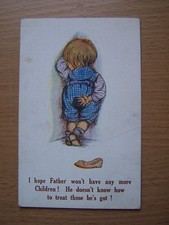
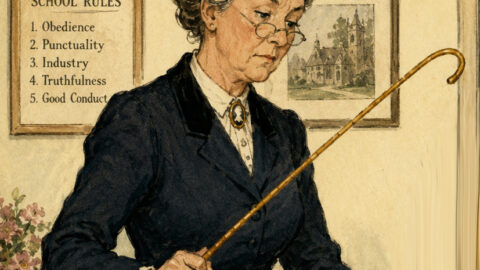
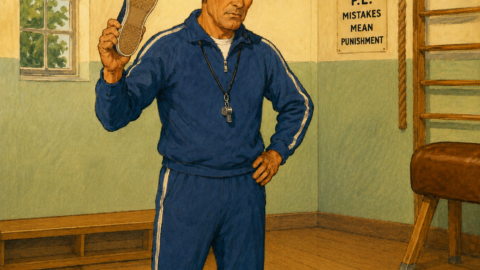
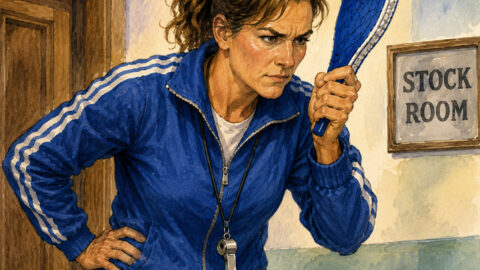
There was a time when corporal punishment was accepted as part of everyday school life. A smack, a slipper, or even the cane was regarded by many parents and teachers as a normal way of maintaining discipline. Children were expected to accept it without complaint, and few questioned whether it was right.
Yet, looking back today, it is impossible not to ask whether some adults were given far too much power over the children in their care.
One story in particular has remained with me. A teacher regularly punished boys and girls by pulling them across his knee and smacking their bare bottoms. Sadly, it seems clear that not every teacher who used corporal punishment did so simply as a form of discipline. Some appeared to take personal satisfaction from the experience, and that thought is deeply disturbing.
Children who were shy, frightened, or too embarrassed to tell their parents were especially vulnerable. If a teacher believed a child would keep silent, that child was far less likely to be protected from behaviour that today would rightly be viewed with suspicion.
I was astonished to hear of one child receiving thirty smacks. Even allowing for the standards of the time, that seems an exceptionally severe punishment. During my own schooldays in the 1920s, such a number would have been considered harsh by many people. It raises the uncomfortable question of whether the punishment was being given for discipline or because the teacher simply enjoyed administering it.
After such a beating, the child’s bottom was left extremely red and sore, making it impossible to sit down comfortably for quite some time. By the time they arrived home, however, the redness had faded to a hot pink, and thankfully there was no bruising. Since children did not usually wander around the house unclothed, their parents would have had little opportunity to notice any marks unless the child mentioned what had happened.
This child was certainly not alone. Many other boys and girls had also been taken over the same teacher’s knee and smacked in exactly the same way. It became widely known that he seemed particularly fond of using this method of punishment on both sexes.
From a modern perspective, this is deeply unsettling. Yet the legal position at the time was very different from today’s. Provided the punishment was regarded as discipline rather than sexual touching, it is doubtful that the teacher would have been breaking the law, even if the punishment involved a bare bottom.
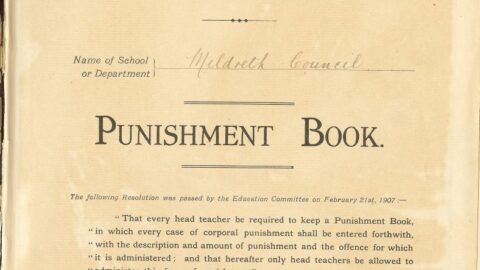
Education Authorities and School Boards often had detailed rules governing corporal punishment. In many schools, only the cane was officially authorised, with the use of the hand or slipper specifically discouraged or prohibited. However, in practice, standards varied considerably between schools, and enforcement was often inconsistent.
Whether this teacher was technically breaking the rules is difficult to say. Legally speaking, several factors would probably have worked in his favour.
The fact that the child’s bottom was only pink rather than bruised by the time they reached home would almost certainly have been taken as evidence that the punishment had not been excessive by the standards of the day. The child believed the punishment was undeserved, but that alone would not have made it unlawful.
If the teacher was smacking large numbers of children, it is almost certain that parents became aware of it. Younger children’s bottoms would have been seen at bath time or bedtime, while older children frequently talked amongst themselves. One child telling their mother that another had been punished was often enough for the news to spread through the community.
Had parents believed the punishments were unreasonable, complaints would almost certainly have followed. The fact that many did not object suggests that, at the time, such discipline was largely accepted by society, however uncomfortable that may seem today.
It is important to remember that historical cases must always be judged according to the law as it existed at the time, not according to today’s legal standards or social attitudes.
Interestingly, some former headmasters have argued that openness made all the difference. One recalled his years at St Peter’s, a state junior school for boys, from 1940 until 1968.
His office could be clearly seen by parents waiting outside to collect their sons. Everyone knew that if corporal punishment was necessary, it would be carried out where parents could observe it. There were no closed doors and no secrecy.
Parents occasionally saw boys being caned across the bottom, sometimes even on the bare bottom, and while such scenes would shock us today, they were widely accepted at the time. The visibility of the punishment reassured parents that nothing improper was taking place and helped to maintain trust between the school and families.
He later worked at a private school until around 1980, where older boys were sometimes instructed to lower their trousers so the cane could be applied either across their underpants or, in certain circumstances, on the bare bottom. Again, classrooms could be overlooked from a pathway used by parents, who were able to see what was happening if they wished.
His belief was that the real problems began only when punishments were hidden behind closed doors. Once teachers started saying, “I won’t tell your parents this time,” suspicion naturally grew. Secrecy removed accountability, and without accountability there was far greater opportunity for abuse.
That, perhaps, is the most important lesson to take from these memories. Corporal punishment itself was once accepted by much of society, whether we agree with it or not. But whenever punishment was carried out in secret, away from the eyes of parents and colleagues, children were left vulnerable. Openness may not have made corporal punishment right, but secrecy undoubtedly made it far easier for those with the wrong motives to misuse the authority they had been given.