In a recent column, Rachel Johnson, sister of Boris Johnson, reflected upon the subject of corporal punishment and her own experiences at school.
She recalled that, as the first girl admitted to an otherwise all-boys preparatory school, she was once discovered after hours taking food from a cupboard reserved for pupils’ treats. For this offence she was offered a choice of punishment: either a beating administered by the headmaster — whose customary implements reportedly included a slipper, cricket bat, or golf club — or the forfeiture of a long-awaited weekend visit with her parents.
Having not seen her parents for the entire term, as was then common practice in many boarding schools, she chose the corporal punishment without hesitation. The headmaster, however, ultimately decided he could not bring himself to strike a female pupil. According to Mrs Johnson, this decision subsequently led him to reconsider the practice altogether, eventually bringing corporal punishment at the school to an end.
Mrs Johnson also remarked, somewhat ruefully, that this episode later led to her name being associated with publications and commentaries devoted to the subject of corporal discipline. She stressed, however, that she held no unusual interest in such matters, though she acknowledged that on a few rare occasions she had smacked her own children.
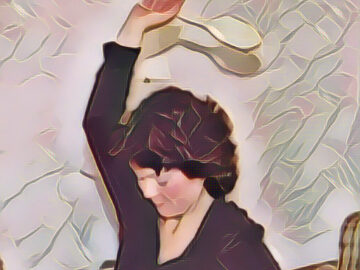
Public discussion concerning corporal punishment has in recent years extended beyond traditional school canes and straps to include a variety of improvised implements. Among the more unusual objects reportedly discussed is the gel-filled wrist support pad commonly used with typewriters and computer keyboards. Designed to elevate the wrists and reduce strain during typing, the pad features a soft upper surface and a non-slip base.
Despite its seemingly harmless appearance, some have alleged that such an object, when used with force, could inflict considerable pain and bruising. Speculation has centred upon the weight of the device and the possibility that the gel filling hardens momentarily upon impact, thereby increasing the severity of the blow. Critics of corporal punishment have pointed to such examples as evidence of the dangers inherent in physical discipline.
One former pupil, recalling his schooldays, described an incident during a canoeing excursion in which a teacher allegedly behaved in an inappropriate manner while changing clothes before students. Though treated lightly by the boys at the time, the former pupil later came to regard the matter as deeply improper.
Historical recollections of corporal punishment continue to emerge from public figures. An article published by the National Trust for Scotland recounted memories of the late Tam Dalyell, well known for raising the constitutional issue later termed the “West Lothian Question.”
Mr Dalyell recalled that, as an eleven-year-old boy, he was required to sign documents transferring his family estate, the House of the Binns, into the care of the Trust. The signing reportedly took place in his headmaster’s study, in the very chair over which he had been caned the previous evening. He later remarked with characteristic humour that it was “the only occasion on which the headmaster lent a boy his fountain pen.”
Meanwhile, debate over the legality of corporal punishment has continued in continental Europe. In France, the Constitutional Council recently struck down a parliamentary amendment that sought to prohibit the use of “bodily violence” by parents against children. The provision had formed part of a broader Equality and Citizenship Bill promoted during the presidency of François Hollande.
Supporters of the amendment argued that the measure would strengthen efforts to discourage the use of slaps and smacking in child-rearing, while opponents contended that the provision had been improperly attached to unrelated legislation. The Council ultimately ruled against the amendment on constitutional grounds.
The French Minister for Families, Children and Women’s Rights, Laurence Rossignol, expressed disappointment at the ruling, maintaining that the measure represented an important symbolic step towards non-violent methods of education. Child welfare advocates similarly criticised the decision, arguing that children should enjoy the same legal protection from violence afforded to adults.
The Constitutional Council also invalidated several other provisions of the legislation, including measures concerning public housing and increased regulation of independent schools.