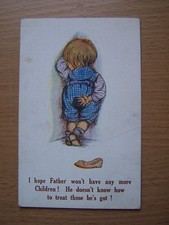
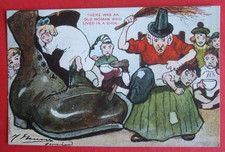
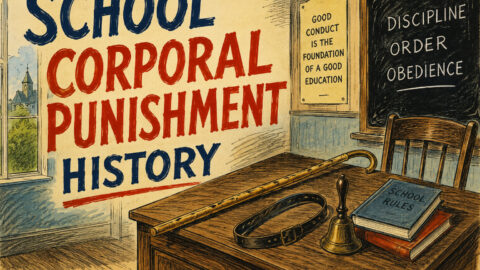
For me, punishments at primary school were something of an unknown quantity. Later, at secondary school, there was usually a clear understanding among pupils about which offences were likely to result in a punishment with the slipper or the cane, and there was a rough sense of how severe the punishment would be. Primary school was quite different. Because pupils generally remained with the same class teacher for an entire year, discipline often seemed inconsistent and unpredictable. The severity of a punishment frequently appeared to depend less on the offence itself and more on the temperament or mood of the teacher administering it. Looking back, every instance of corporal punishment that I received during my primary school years was administered by a woman.
My first experience of corporal punishment occurred when I was still in the infant school. The headmistress summoned me to her office, hauled me over her knee, and expressed her displeasure with a smacking on my backside. The memory remains remarkably vivid, even decades later. Although I know it must have hurt, I can no longer remember the exact level of pain. What I do remember clearly is the shock. I was only six years old and had never before received that kind of punishment, either at home or at school.
The physical discomfort was only part of the experience. Equally upsetting was the stern lecture that accompanied it and my overwhelming sense that the punishment was undeserved. Until then, I had viewed adults as people who were always truthful and fair. That incident shattered that belief. Reduced to tears, I came away with the unsettling realisation that adults could sometimes be unjust, and that they possessed a power that made them both intimidating and, at times, frightening.
By the time we progressed to the junior school, usually at the age of seven or eight depending on one’s birthday, the school environment changed considerably. The boys and girls were separated, occupying different floors of the large Victorian building, and there was virtually no interaction between the two groups during the school day. Among the boys, corporal punishment remained a normal part of school life. Rumours circulated that the headmistress of the girls’ department kept a cane in her office. However, I never personally witnessed or heard of it being used, and over time I became convinced that it was little more than playground folklore.
The slipper was never used in our part of the school either. Instead, teachers relied on more immediate methods, usually involving a ruler or their own hand. One of the most feared members of staff was the music teacher, Miss M. Very few pupils escaped receiving a sharp rap across the knuckles from her ruler at some point. In truth, it was not particularly painful compared with other punishments, unless the edge of the ruler happened to catch a knuckle at the wrong angle, which could produce a surprisingly sharp sting.
Miss M also had a reputation for slapping pupils on the arms or legs when she felt discipline was required. Fortunately, I had a natural aptitude for music and generally stayed on her good side, which meant I rarely experienced the full force of her temper. On one memorable occasion, I managed to pull out a loose tooth during one of her lessons. Thankfully, my moment of distraction earned only a brief encounter with the ruler rather than one of her more vigorous punishments.
My own class teacher, Mrs W, was a very different matter. I disliked her intensely for a variety of reasons, and she remains one of the least pleasant teachers I encountered during my school years. She had several favourite methods of punishment. One involved ordering pupils to pull down their knee-length socks before striking the backs of their legs repeatedly with a ruler. The pain was immediate and lingering, leaving the skin smarting for quite some time afterwards.
Another of her preferred punishments was a public spectacle designed to maximise embarrassment as well as discomfort. The offending pupil would be called to the front of the classroom and instructed to roll up a shirt sleeve. They then had to place one hand on the opposite shoulder, exposing both the upper and lower arm. Mrs W would proceed to deliver a series of hard slaps along the exposed arm, often repeating the process on both sides.
What made this punishment particularly unpleasant was the anticipation. If several pupils were lined up awaiting their turn, it became possible to gauge Mrs W’s mood by observing the force she used on those ahead of you. Watching her arm rise and fall while knowing your own turn was approaching added a psychological dimension to the punishment. Standing before the entire class only increased the sense of humiliation. The slaps themselves were painful enough, but the public nature of the ordeal often made it feel worse.
The most painful punishment I ever received, however, stemmed from an incident that took place outside school altogether.
One Saturday afternoon, I was playing with a group of friends in the street outside a friend’s house. As children often do, we were larking about, throwing crab apples and generally causing harmless mischief. During one throw, I badly misjudged my aim. Instead of landing where intended, the crab apple flew directly into a small window above a nearby front door and shattered the glass.
The reaction of the group was immediate. The moment the window broke, everyone scattered in all directions. Faced with the choice of running away or taking responsibility, I froze. The house belonged to the family of another friend, and in a moment of what can only be described as youthful honesty—or perhaps panic—I walked up to the front door and knocked.
When my friend’s father answered, I admitted exactly what had happened and accepted responsibility. To my surprise, he was neither angry nor aggressive. Instead, he listened calmly and suggested that I speak to my parents so that arrangements could be made to repair the damage. His measured response was entirely unexpected and left a strong impression on me, particularly given how frightened I had been moments earlier.