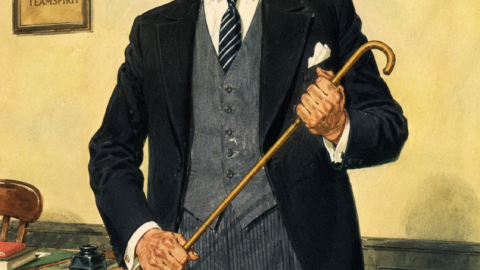
For many pupils who attended British schools during the era when corporal punishment was commonplace, caning was an accepted—if deeply feared—part of school life. While experiences varied from one school to another, certain aspects of the punishment were remarkably consistent: the anticipation, the formality of the procedure, and the vivid memories it left behind.
Some former pupils recall that a well-delivered cane stroke could occasionally wrap around the edge of the buttocks or upper thigh, producing an especially sharp and intense pain. Such strikes appeared deliberate rather than accidental, suggesting that experienced disciplinarians understood precisely how to maximize the impact of the punishment.
The psychological aspect of caning was often as significant as the physical pain. Long before the first stroke landed, there was usually a period of waiting—sometimes hours or even days—during which the offender knew what lay ahead. This anticipation could be deeply unsettling. Formal procedures added to the sense of occasion: being summoned from class or study, reporting to a senior member of staff, bending over a chair or desk, and waiting for the punishment to begin.
Many former boarders describe corporal punishment as an unavoidable feature of school life. It was certainly not something pupils wanted to experience, but it was regarded as part of the disciplinary system. The possibility of receiving the cane was ever-present, and boys generally tried hard to avoid earning such punishment.
One former pupil remembered punishments ranging from hand-spankings at preparatory school to canings at public school. At prep school, his housemaster would administer a spanking over the boy’s shorts after first checking that no extra padding had been added. At public school, punishments were considerably more formal. A typical sentence involved six strokes of the cane, although more serious or repeated offences could result in a greater number.
Another former student recalled being sent to the headteacher’s office in the mid-1970s after repeatedly disrupting lessons and showing disrespect to staff. Upon arrival, he was ordered to bend over a chair and received six strokes of the cane. Decades later, he still remembered the intense stinging sensation.
For many boys, however, the most difficult part was the period of waiting. One former boarder vividly remembered sitting through evening study periods knowing that he had been sentenced to six strokes. The sound of approaching footsteps, the summons from a prefect, and the walk to the punishment room often felt worse than the punishment itself.
He described entering a dimly lit area beneath the school chapel, where he was instructed to bend over, part his feet, and grasp his ankles. The headmaster carefully positioned himself before delivering the strokes. According to his recollection, the first stroke brought shock more than pain. The second registered immediately and intensely. By the third and fourth strokes, maintaining position became increasingly difficult. The fifth seemed almost unbearable, while the sixth represented the peak of the ordeal. Afterwards, his greatest challenge was returning to the common room without showing emotion in front of his peers.
Many former pupils shared similar memories of the first stroke. It was frequently described as the most shocking moment of the punishment. One recalled a deep, searing sting that took his breath away and made him instinctively want to stand upright and clutch the affected area. Even after the caning was over, sitting at a desk could remain uncomfortable for hours. Marks often lasted for days and occasionally for weeks.
Another former student, punished at age eighteen after an altercation with another boy, was given a choice between expulsion and corporal punishment. Choosing the latter, he was ordered to lower his trousers and underwear before receiving six strokes across the bare buttocks. Though he managed to maintain his composure, he later admitted that the experience was among the most painful disciplinary measures he had ever endured.
What emerges from these recollections is not simply a description of physical punishment, but an insight into a vanished educational culture. The cane represented authority in its most visible form. While many who experienced it regarded it as harsh and unpleasant, it was nonetheless accepted as part of everyday school discipline in Britain for much of the twentieth century.
Today, such punishments belong to history. Yet for those who lived through them, the memories often remain remarkably vivid—combining fear, humiliation, anticipation, pain, and, above all, a lasting awareness of the authority that the cane once symbolized in schools.