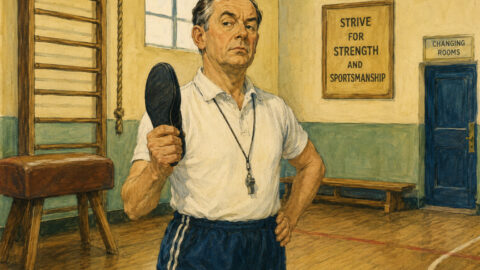
For many boys who attended British schools during the mid-to-late 1970s, the physical education department was where they were most likely to encounter the slipper. While headmasters and classroom teachers certainly administered punishments, PE teachers often seemed to make more frequent use of immediate discipline, largely because they operated in a less controlled environment than a traditional classroom.
Games fields, gymnasiums, changing rooms and athletics tracks provided far greater opportunities for mischief, disruption and horseplay. Pupils were frequently spread out across large areas and often beyond the direct supervision that a classroom teacher enjoyed. In such circumstances, PE staff tended to establish authority quickly and visibly. A punishment delivered on the spot served not only as a reprimand for the offender but also as a warning to everyone else present. Seeing a boy receive a slippering during a games lesson was often enough to ensure that the remainder of the class behaved for the rest of the period.
Craft, woodwork and metalwork teachers could also develop reputations for being quick to punish, perhaps for similar reasons. Workshops contained tools, machinery and potentially dangerous equipment, and maintaining discipline was considered essential. Nevertheless, PE teachers often stood out because of the frequency with which they resorted to the slipper.
Discipline and Deterrence
Not every slippering was intended as a severe punishment. In many cases, the PE master’s objective appeared to be deterrence rather than outright retribution. A few sharp strokes were often administered as a warning, intended to make the recipient think twice before repeating the offence. The message was clear: improve your behaviour now or face a much more severe punishment later.
That said, many PE teachers had few reservations about delivering a genuinely painful punishment when they believed circumstances justified it. The distinction between a warning slippering and a full-scale “giving of the best” was usually well understood by pupils. The latter was something most boys were keen to avoid.
One aspect of PE discipline that drew criticism was the frequent use of collective punishment. Rather than identifying the individual responsible for a disturbance, some teachers preferred to punish an entire group. This might involve extra laps of the gym, sets of press-ups, running exercises or, on occasion, a few strokes of the slipper administered to each member of the group. From the teachers’ perspective it encouraged boys to regulate each other’s behaviour. From the pupils’ perspective it often felt unfair, particularly when innocent boys were punished alongside the guilty.
The PE Teacher’s Reputation
As in any profession, personalities varied enormously. Some PE teachers used punishment sparingly and were generally respected. Others developed fearsome reputations.
Many former pupils can recall masters who seemed to administer the slipper almost routinely, with several boys receiving punishment during a single lesson. If such practices were repeated throughout the school day, the number of punishments delivered could be remarkable. For some pupils, these teachers appeared less interested in maintaining discipline than in exercising authority for its own sake, leading to accusations of bullying or excessive severity.
Whether such assessments were fair or influenced by youthful resentment is difficult to determine decades later, but it is clear that certain PE teachers became legendary figures within school folklore because of their enthusiasm for corporal punishment.
The School Slipper
The implement itself was usually a gym shoe or plimsoll rather than an actual slipper. These shoes were typically made from canvas with a thick rubber sole and were widely available in schools. Many teachers kept a dedicated punishment plimsoll in a desk drawer, locker or sports office.
Over time, these punishment shoes often became modified through use. The canvas around the heel might wear away or be deliberately cut back, increasing the flexibility of the rubber sole. This allowed the shoe to whip forward with greater force when swung correctly, producing the sharp, stinging impact that recipients remembered so vividly.
Opinions varied regarding which type of plimsoll was most effective. Smooth-soled gym shoes were said to produce a sharp, noisy crack on impact, often leaving a visible red mark. Shoes with a more pronounced tread pattern tended to create a duller, heavier blow that some pupils considered more bruising. Whatever the design, experienced teachers generally knew how to maximise the effect.
The size of the plimsoll was not necessarily the decisive factor. Most punishment shoes were adult-sized, but effectiveness depended more upon the technique of the person wielding it. A skilled practitioner holding the shoe by the end of the heel could generate considerable speed and flexibility, allowing the sole to strike with a distinctive snapping action.
Methods of Administration
Techniques varied from teacher to teacher. Some required boys to touch their toes before receiving the strokes, ensuring that the seat of the trousers was stretched tight. Others preferred the recipient to bend forward with hands on knees. The position adopted often depended upon the traditions of the particular school or the personal preference of the teacher.
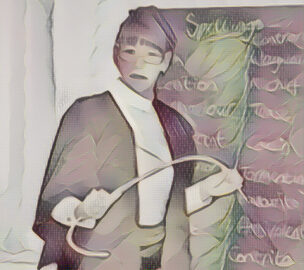
Many modern reconstructions and dramatic portrayals fail to capture how the punishment was actually administered. Former pupils frequently note that the shoe was not simply pushed or swatted against the recipient. Instead, it was typically held at the very end of the heel and swung so that the flexible sole struck the target area with maximum force and a sharp cracking sound.
Boys’ and Girls’ Schools
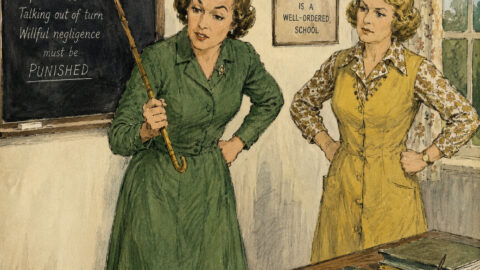
Practices varied between boys’ and girls’ schools. In many schools, female PE teachers or gym mistresses also administered slipperings, although details were often less widely known among boys. Stories circulated of girls receiving punishments after games lessons, particularly for poor effort, misconduct or breaches of discipline, though such accounts were usually second-hand.
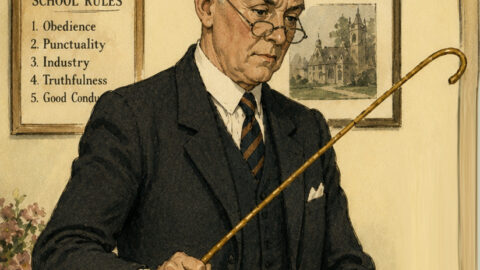
In some schools the headmaster reserved the cane for serious offences while other staff members relied on the slipper. Senior mistresses might possess their own canes and administer punishments independently within the girls’ section of the school.
Borrowed Plimsolls and Teacher-Owned Implements
Although many teachers maintained their own punishment shoe, this was not universal. Some would occasionally use a boy’s own plimsoll if none was immediately available. In certain classrooms it became almost a ritual: when a pupil was called forward for punishment, classmates would eagerly offer their shoes. Teachers often selected one belonging to an older or larger boy, reasoning that a bigger plimsoll would prove more suitable.
Nevertheless, dedicated teacher-owned plimsolls remained the norm. These shoes became familiar objects within school life, recognised by generations of pupils and often acquiring a reputation almost as notable as that of the teacher who wielded them.
A Reflection of Its Time
Looking back, the widespread use of the slipper by PE teachers reflects a very different educational culture from that found in schools today. Corporal punishment was regarded by many teachers, parents and pupils as a normal part of school discipline. Whether viewed as an effective deterrent, an unfair practice or something in between, it was undeniably a significant feature of school life for many children during the 1970s.
The PE department, with its unique environment and traditions, became one of the places where this culture was most visible. For those who experienced it, memories of the gym shoe, the command to bend over, and the unmistakable crack of rubber on cloth remain among the most vivid recollections of their school years.