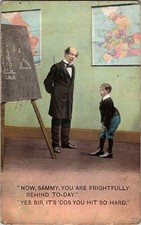
Looking back on my school days, I can still remember one particular incident that seemed to surprise an adult far more than it surprised the pupils involved. A dinner lady appeared genuinely astonished that members of our class had received a smacking from our teacher. Her reaction puzzled me at the time because ours was certainly not a school that shied away from corporal punishment. Physical discipline was a recognised and accepted part of school life, and most pupils expected that serious misbehaviour could result in some form of punishment.
In hindsight, the dinner lady’s surprise may have had less to do with the punishment itself and more to do with the teacher who administered it. Our class teacher was known for being strict and maintaining good order, but she rarely resorted to corporal punishment. Most of the time, a stern word, extra work, or other classroom sanctions were enough to keep discipline. Perhaps the dinner lady assumed that, because our teacher seldom used physical punishment, she would never do so at all.
To be fair, our behaviour had not exactly been exemplary. The trouble had begun in the playground and gradually spilled over into the classroom. Several of us had been indulging in high spirits and constant messing about, disrupting lessons and distracting other pupils. The situation had become serious enough that the teacher had already separated some of us in class in an attempt to curb the disruption. Being reported for misbehaviour during the dinner break was likely the final straw. From the teacher’s perspective, repeated warnings and earlier measures had failed, and stronger action was considered necessary.
My experiences took place in England during a period when corporal punishment was commonplace throughout the education system. From the late 1940s through to 1960, physical discipline was regarded as a normal and legitimate method of maintaining order in most primary schools. Both boys and girls could be punished in this way, and few parents questioned the practice because it reflected wider attitudes in society at the time.
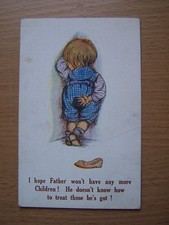
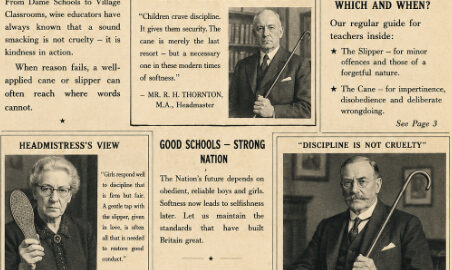
Different schools employed different methods. Some primary schools used the cane, but mine did not. The most severe punishment available at my school was the slipper. This was typically a flexible gym shoe with a rubber sole, used to strike the clothed buttocks of a pupil who was required to bend over. Depending on the nature of the offence, a pupil might receive anything from a single stroke to several. Although the prospect was unpleasant and dreaded by most children, it was accepted as part of school discipline.
When I moved on to a boys’ secondary school, corporal punishment remained an established feature of school life. The slipper was commonly used by teachers as a classroom punishment for various offences, ranging from persistent disruption to failure to follow instructions. For more serious breaches of discipline, the Headmaster could administer the cane, a punishment that carried considerable weight and was feared by the vast majority of pupils.
An interesting feature of the school’s disciplinary system was the role played by the prefects. These senior boys were entrusted with handling many minor disciplinary matters that occurred outside the classroom. They operated a weekly disciplinary court where offenders were brought before them. Repeat offenders could find themselves receiving the cane as a consequence of their continued misconduct. While I experienced my share of school discipline, I was fortunate enough never to be caned.
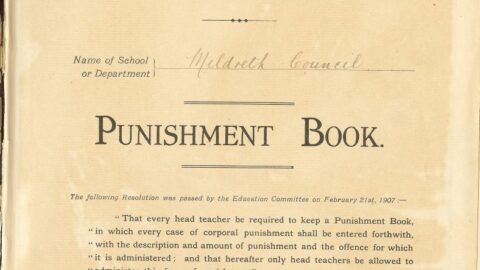
The place of corporal punishment in British schools gradually changed as attitudes towards child welfare, education, and discipline evolved. What had once been considered entirely normal increasingly came under criticism. Eventually, corporal punishment was abolished in state schools in England in 1986 and later in private schools in 1999, bringing an end to a practice that had been part of British education for generations.
As for my own view of the matter, I recognise that opinions differ strongly. Speaking purely from personal experience, I believe that when corporal punishment was applied fairly, sparingly, and within clear limits, it often served as an effective deterrent and helped maintain discipline. I saw little evidence of lasting harm among those who received it, though I appreciate that others may have had very different experiences.
At the same time, I cannot ignore the fact that educational approaches have changed significantly. Modern schools rely on a range of alternative disciplinary measures, including detentions, behavioural support programmes, isolation units, suspensions, and exclusions. Whether these methods are more effective remains a matter of debate. Many people argue that they are more humane and better suited to contemporary educational values, while others believe that schools have lost an important disciplinary tool.
Whatever one’s opinion, there is no doubt that corporal punishment formed a significant part of school life for many generations of British children. For those of us who grew up during that era, it was simply one of the accepted realities of education, reflecting the social attitudes and expectations of the time.