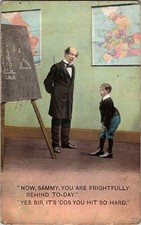
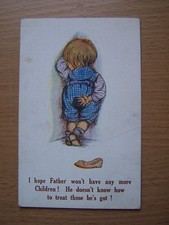
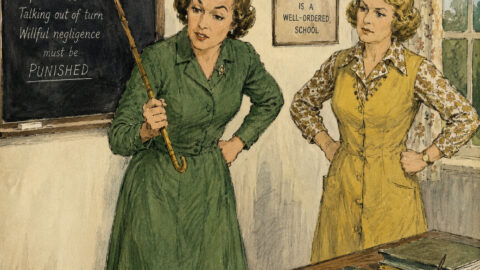
There was a time when corporal punishment was as much a part of British school life as morning assembly and the ringing of the school bell. To today’s generation it may seem almost unbelievable, but for many of us who attended grammar and public schools during the 1950s and 1960s, the cane and the slipper were accepted facts of school discipline. Most pupils did everything they could to avoid them. Yet, curiously enough, there were always a handful of boys who seemed to welcome a sound thrashing.
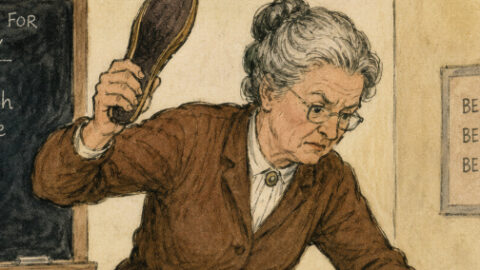
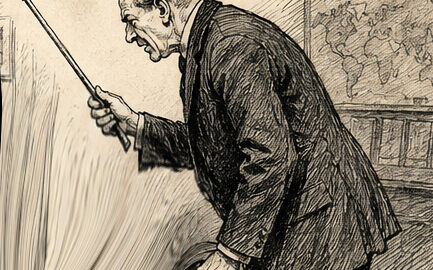
One incident from my own schooldays has stayed with me for more than half a century. I was in the Fourth Year at The Skinners’ School, Tunbridge Wells, Kent, during the 1950s. One of the few masters who still made regular use of corporal punishment never seemed to be without either a cane or a gym slipper tucked under his arm. If a boy stepped out of line, there was every chance he would be summoned to the front of the class, bend over, and receive several sharp strokes across the seat of his trousers.
Now, this being an all-boys school, practical jokes and dares were never in short supply. One particular lad announced that he intended to discover whether carrying a Bible inside his trousers would soften the effects of a caning or slippering. The whole class knew of his plan beforehand. He tucked the Bible into the back of his trousers and spent the lesson deliberately misbehaving, calling out answers without permission and generally making a nuisance of himself, fully expecting to be hauled to the front for a well-deserved whacking.
We watched with barely concealed excitement, waiting for the inevitable summons.
But, for reasons known only to the master himself, the punishment never came. Whether the teacher suspected something was afoot or simply chose to ignore the boy’s antics that day, we shall never know. The great experiment ended before it had even begun, leaving us all wondering whether the Bible would indeed have provided any protection.
Years later, while at university, the subject of corporal punishment arose during a discussion on education. One student told us of an extraordinary tradition at his own school. During one particular year, he claimed, the boys had formed what they jokingly called a “Caning League.” Every visit to the Headmaster for the cane earned points, and the object was to finish the term at the top of the table. Far from fearing punishment, some boys deliberately misbehaved in order to improve their standing in this bizarre competition. He admitted, with no little pride, that he had been one of the leading contenders.
Whether this was unique to his school or more widespread, I have never discovered.
Similar attitudes existed elsewhere. At one very traditional grammar school during the 1960s, a small group of boys seemed positively proud of the angry red cane marks they carried across their backsides. To them, the marks were almost badges of honour, proof that they had challenged authority and survived the consequences.
One master in particular, known universally by the nickname “Cloddy,” taught mathematics. His methods were predictable. Failure to hand in homework earned a detention. Miss that detention and another, longer one followed. Ignore that as well, and the matter was referred to the Headmaster, where the cane awaited.
Oddly enough, many boys of thirteen or fourteen preferred a brisk caning to enduring two hours sitting silently after school under Cloddy’s watchful eye. A few sharp strokes with the cane lasted only seconds. Two hours of detention seemed an eternity. As one punishment was over almost before it had begun, many chose the cane simply to get the matter behind them.
Corporal punishment was not always delivered with the cane. Many teachers preferred lines, essays or tedious copying exercises. One former pupil recalled having a considerable schoolboy crush on his English teacher. During one lesson she warned that the next person to speak would be given three hundred lines.
Determined to attract her attention, he deliberately whispered to the boy beside him.
His reward was precisely as promised: three hundred times he wrote, “Talking in class will bring about instant punishment. This is it.” Combined with his normal homework, it made for a very long evening indeed. Apparently he was not discouraged, for later he engineered another offence which resulted in copying three complete pages from the school dictionary.
Others admitted to volunteering for punishment when they needn’t have done. One former pupil confessed that on several occasions he accepted responsibility for a group offence simply so he could receive the slipper. The punishment, he recalled, left a warm stinging sensation which he did not altogether dislike. However, he was quick to add that he only volunteered when he knew it would be the slipper. Had there been any possibility of facing the cane instead, his enthusiasm disappeared remarkably quickly.
There was another boy at one school who seemed to be in the Headmaster’s study almost weekly for the cane. Yet he emerged each time apparently cheerful and entirely untroubled by the experience. His behaviour prompted classmates to wonder whether there existed some strange psychological relationship between punishment and offender.
At my own secondary school there were two notorious lads who seemed almost immune to the deterrent effect of corporal punishment. After receiving the cane they would stroll back into class grinning broadly, laughing with one another as though nothing unusual had happened.
Most boys reacted very differently. A single caning was enough to ensure they did everything possible to avoid another. The anticipation alone was dreadful. Waiting outside the Headmaster’s study while the unmistakable swish of the cane echoed from within was often worse than the punishment itself. Many emerged rubbing their backsides, fighting back tears, while others openly wept. The sting of the cane lingered for hours, and sitting comfortably afterwards could prove difficult.
Yet those two boys remained completely unfazed. Having accepted the inevitable, they seemed to regard each caning as simply wiping the slate clean. They would serve their punishment, laugh it off, and begin collecting offences all over again.
Curiously, however, their carefree attitude never encouraged anyone else to follow their example. For the overwhelming majority, one encounter with the cane or slipper was more than enough.
Looking back, it is a strange chapter in British educational history. Corporal punishment was intended as a deterrent, and for most pupils it undoubtedly was. Yet there were always those few individuals who wore their punishments almost as a badge of honour, turning discipline into a peculiar game. It remains one of the more curious memories of an era that has now passed into history.