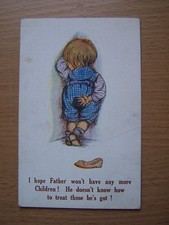
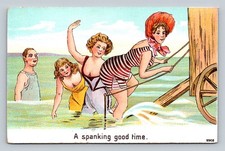
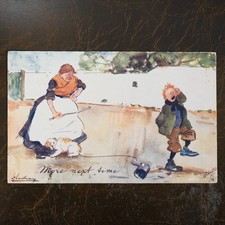
“Although, as he told them, he was happy to trust them and risk being let down, and although his ideal when he ser out in 1863 was to rule by kindness, Wilson did beat boys. Those who lied or cheated were invariably caned. Among snippets of evidence about his practice there is T. Aylesbury Brown’s recollection of only once seeing the tawse in the five years he was at school between 1889 and 1893. Even so, it was used with vigour a horrifying twelve times to each hand of a boy who had been impertinent to a master. Wilson, who had limped to the classroom to give the strap, sent the boy to his dormitory, from where, apparently, he packed himself off home.”
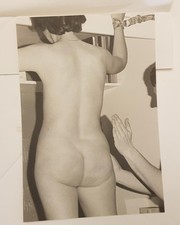
“A delay like that would have saved Wilson some embarrassment at one swimming sports in the 1870s, when he noticed fearful bruises on the back (sic) and legs of young Ernest Jackson, and learnt to his horror that they were the marks of his own tawse. ‘I always bruised very easily’, Jackson wrote later.”
1920s: “Masculinity was at a high pitch in the boarding-houses, where prefects ruled supreme and often inflicted corporal punishment. Its results were visible in summer at the school baths where boys, by tradition naked, often wore ugly stripes.”
Reverend Doctor Francis Brown, Headmaster: “Students felt he was almost as omnipotent as God, and nearly as distant except on Monday mornings, when a large contingent of backsliders knew his wrath at close quarters through the cane.”
Mr E.T. Williams, Housemaster: “Ian Nicholson remembered ‘Billy Lop’ Williams quoting his favourite poem, ‘Drake’s Drum’, in one of the dormitories. When he came to ‘Captain, are thou sleeping there below?’, a voice from under a bed responded, ‘Aye, Aye, sir!’ The offender soon felt six of the best, but then, as always happened when he caned one of his favourites, Billy made it up to him with coffee and Banbury tarts.”
Sir James Darling, Headmaster: “After receiving gifts from the school and thanking them with his usual wit and power, the headmaster, with a touch of humour, to everyone’s delight, broke his cane and threw down his mortar board.”
“Brian Jones thought that, because it was small, well-ordered and happy, the school of the 1920s was in certain ways ‘outstandingly civilised’. The house and the isolation welded it together. The boys were a nice lot who treated each other well; there was no brutal caning or dreadful bullying. He believed that nobody questioned the numerous rules, automatic punishments, beating and detentions.”
“House captains could cane. Hugh Luiggi (a founding member of Francis Brown 1937-40) remembered a boy caned for insulting the King by sticking his image upside down on a letter. Luiggi thought that caning, the preferred method of enforcing discipline at Corio, was weakened by its frequency and the lack of distinction in degree of punishment. Had he been in Manifold, he would have found life much tougher.”
‘Wesley College: The First Hundred Years’ by Geoffrey Blainey, James Morrisey and S.E.K. Hulme.
It contains far less corporal punishment material than others , but there’s still some (not much though from a school whose old boys have often referred to their schoolmasters as ‘the men who tanned the hide of us’).
Again, a particular term needs to be explained with regard to Wesley – that of ‘President’. In the early days of Wesley College administrative power in the school was split between two people – President and Headmaster – the Headmaster was pretty much as you’d expect, the President was functionally a boarding house master and chaplain – however he had a position on the School Council (which the headmaster did not) and therefore could exert considerable pressure on the Headmaster.
Wesley College. This history is older than the others I’ve used so far (from 1967), because I do not have access to a more recent history of Wesley, if one has been written.
Professor Henry Martyn Andrew, Headmaster; Reverend James Swanston Waugh, President: “Andrew’s term as headmaster opened ominously. It seems that in February 1876 some young boys dawdling on their way home from school threw stones and broke windows of a woman’s house. Though boys did not wear an identifying uniform in those days, the woman knew which school the stone-throwers went to, and she called on President Waugh and protested.
Waugh and Andrew made investigations and poked through lies or evasion until they found the culprits. They made them bring money to school to pay for the windows and, as punishment for telling lies, gave them the option of voluntarily leaving the school – it was not the same as expulsion, Andrew explained – or of accepting a flogging. Several chose the flogging. Waugh approved of this punishment and Andrew had to give it. One of the boys, a twelve-year-old named Albert Pilley, was hit severely.
It seems that Andrew lost his temper and hit the boy’s back and shoulder about 21 tunes with, a cane. The boy’s father got medical advice about his son’s bruises, and legal advice about his rights. A few days later Andrew had to appear in the Prahran Court on a charge of unlawful assault, a charge which could lead to imprisonment.
The contentious issue was not whether Andrew had flogged the boy but whether he had done so with undue severity. Andrew took the case seriously enough to engage the brilliant advocate, J.L. Purves.
Evidence in his defence was given by Howell Thomas, the school’s second master who had witnessed the flogging; by the Reverend Mr. Waugh and by E. E. Morris who was the new headmaster of Melbourne Grammar School; by Professor Irving who was now at Hawthorn Grammar School, and a medical practitioner. Irving told the court that during his reign he had a rule always to flog a boy for persistent lying, and that he had usually flogged one boy each week; by the standards of the day he was probably lenient. Andrew told the court that he had had to punish the boys in order to save them from the police court.