Thoroughly intimidated, I stepped into the Headmaster’s study feeling as though I were walking through a dream. My nerves were so acute that I scarcely noticed the room’s impressive surroundings. The walls were lined with beautifully crafted oak panelling, interrupted only by towering bookcases packed with volumes whose titles hinted at decades of scholarship and tradition. A vast desk dominated the room, its polished surface gleaming beneath the morning light. Rich Persian carpets softened the floor, while a brown leather sofa and matching armchairs stood ready for visitors fortunate enough to be received in more pleasant circumstances.
My attention, however, was drawn irresistibly to a particular corner of the room, situated just to the left of the Headmaster’s desk. It was an area that seemed to possess a gravity all of its own, silently commanding the attention of anyone unfortunate enough to enter the study under disciplinary circumstances. Before long, I would learn that many boys referred to it simply as the “Swishing Zone.”
At its centre stood what appeared, at first glance, to be a small vaulting horse of the type found in a school gymnasium. A closer look revealed that it had been specially modified. Leather restraints were fixed securely to each of its four legs, while broad leather straps hung from beneath its padded centre and along its sides. The equipment looked both purposeful and forbidding.
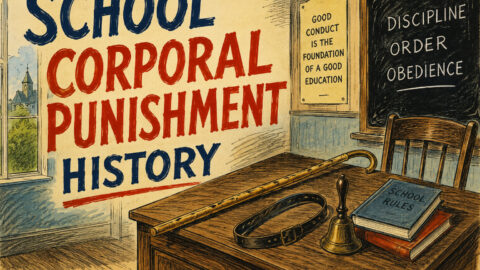
Yet it was not the horse itself that truly captured my attention. Mounted on the wall directly behind it was a glass-fronted display cabinet. Inside, arranged with almost military precision, were six rattan canes. Each differed slightly from the others in length, thickness, and curvature, but together they formed a display that was impossible to ignore. The polished crook handles gleamed under the light, and I could not help imagining the painful purpose for which they were kept. A sinking feeling settled in my stomach as I contemplated the possibility that one of them might soon be put to use.
“Yes, Spockings,” came the Headmaster’s voice, calm and measured. “That is what some of the boys refer to as my Swishing Zone. It is not a place many wish to visit twice.”
I turned away from the display and faced him.
Seated behind his enormous desk, the Headmaster regarded me steadily. His elbows rested upon the polished wood, his fingers intertwined beneath his chin. His eyes were intelligent, sharp, and penetrating, giving the impression that very little escaped his notice. As they travelled slowly from head to toe, I felt as though every aspect of my character was being weighed and assessed. I was only a first-form boy, yet under that scrutiny I felt as though my entire future hung in the balance.
“Now, Spockings,” he began, “do you believe that the disturbance you were involved in on the corporation bus yesterday warrants a painful visit to that corner of the room?”
“No, Sir,” I replied quickly. “I didn’t start it. It was the boys from the secondary modern school. They began it by teasing me and saying unpleasant things about this school.”
“Ah,” he said thoughtfully. “So you considered yourself to be defending the honour and reputation of our school?”
“Yes, Sir. I suppose I was.”
The Headmaster nodded slowly.
“And yet, while defending the school’s reputation, it never occurred to you that becoming involved in a public fight might do far more damage to that reputation than a few foolish remarks ever could?”
I lowered my eyes.
“No, Sir.”
“I am afraid,” he continued, “that the public is unlikely to view the matter in the way you have described it. What they saw was a bus forced to stop on a main road because one of my pupils was engaged in a fight with boys from another school. Such an incident reflects badly upon everyone involved.”
His voice remained calm, but that somehow made his words all the more effective.
“I have already spoken with the Headmaster of the other school,” he went on. “He shares my view entirely. We both agree that the behaviour displayed was unacceptable and has done considerable harm to the reputations of our respective schools. He has informed me that the two boys involved will be receiving severe punishment this morning.”
The room seemed suddenly smaller.
“Now then,” he said. “What punishment do you believe you deserve? What consequence would be appropriate for your actions?”
I realised immediately that I had been placed in a difficult position. If the other boys were to receive such serious punishment, it seemed unlikely that I could expect leniency. Nevertheless, there seemed little harm in making an attempt.
“Well, Sir,” I said cautiously, “as I didn’t start the trouble, I thought perhaps lines or detention might be fair.”
The Headmaster raised an eyebrow.
“Oh, you do, do you?”
There was a brief pause.
“Yet you have omitted one rather important detail. Although the other boys may have provoked you, was it not you who threw the first punch?”
The question struck home. His tone left little doubt that he already knew the answer. Any attempt to deny it would only make matters worse.
“Yes, Sir,” I admitted reluctantly. “I suppose it was.”
“I see.”
The Headmaster leaned back slightly.
“So those two boys are to be punished for an incident that ultimately began with your actions. Do you not feel some responsibility for that?”
“If you put it that way, Sir,” I said quietly, “then yes, I suppose I do.”
“Well,” he replied, “that is precisely how I put it.”
His gaze remained fixed upon me.
“So, as the boy who escalated the situation from words to violence, do you not consider that your responsibility is greater than theirs?”
There was little point arguing.
“I suppose so, Sir.”
“Very good.”
The Headmaster folded his hands once more.
“If I were to tell you that each of those boys is to receive six strokes of the cane this morning, what punishment would you consider appropriate for yourself?”
Desperately searching for some compromise, I ventured a hopeful suggestion.
“The same, Sir… and perhaps some lines as well?”