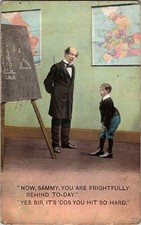
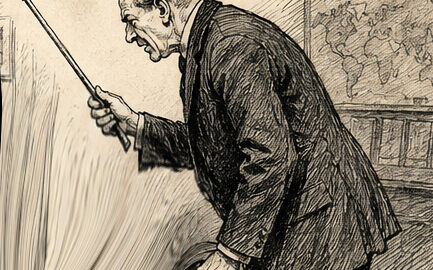
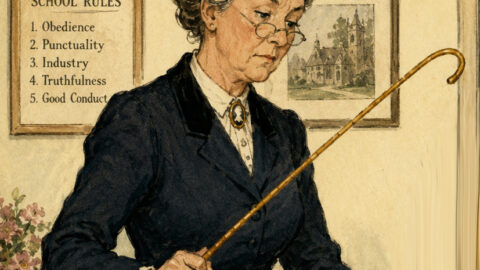
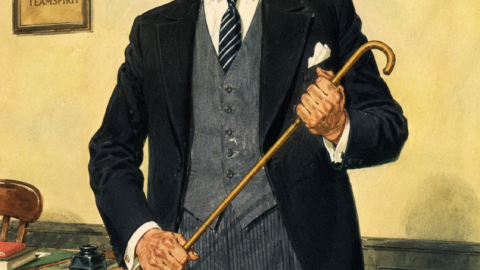
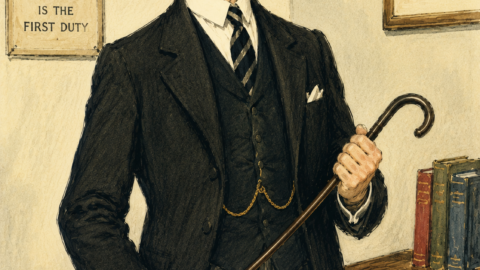
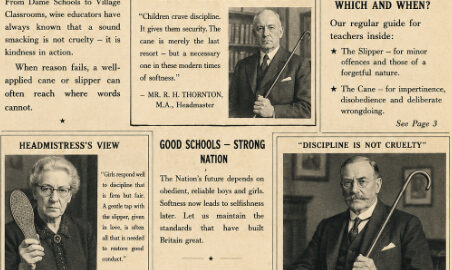
For most pupils, the prospect of such punishment was something to be feared rather than experienced. The mere sight of the headmaster carrying his polished rattan cane was enough to silence the noisiest classroom, and stories of boys returning from the study rubbing sore backsides served as a warning to everyone else.
One former pupil recalls that, from his early teens, he became unusually fascinated by corporal punishment. His interest did not arise because it was used both at school and at home, but after reading a children’s novel by the American author Richard Peck. One particular passage describing a punishment left a lasting impression upon him, and from then on he found himself increasingly curious about the subject.
Whenever word spread that a boy was due to be caned, he found himself listening from a respectful distance. At his school, canings were normally carried out during the lunch hour in the Headmaster’s office. A bench outside the office window became a familiar vantage point for curious pupils. Little could be heard beyond the occasional muffled sound, but even that was enough to remind everyone that discipline was being administered.
The cane itself held an almost mythical reputation among the boys. Reserved for serious offences such as bullying, theft or persistent disobedience, it represented the school’s ultimate sanction. Those who received it usually did so in private, although the evidence often became visible later in the changing rooms after games. Raised red welts across a boy’s buttocks were unmistakable, and such marks discouraged most boys from ever wishing to discover the experience for themselves.
Curiosity, however, can sometimes outweigh common sense.
When the headmaster announced a new rule requiring pupils to wear cycle helmets on journeys to and from school, he warned that anyone breaking the regulation could face the cane. Seeing what seemed an opportunity to satisfy his curiosity without committing a truly serious offence, the pupil deliberately ignored the rule.
His gamble very nearly failed. At first it appeared he would receive a lesser punishment, but eventually the headmaster decided that the cane would indeed be administered. Standing in the study, waiting for the inevitable, he began to question whether he had made a dreadful mistake.
The punishment itself proved to be a sobering experience. Although it answered the question that had occupied his imagination for so long, the reality was far harsher than he had expected. The sharp sting of each stroke quickly developed into an intense burning pain that lingered long afterwards. Sitting comfortably became difficult for some time, and the vivid welts left by the cane served as a constant reminder of the encounter. Looking back, he admits that although part of his curiosity had been satisfied, he never again deliberately sought such a punishment.
Ironically, he was caned once more later during his school career, this time through ordinary circumstances rather than design. Had he known that a second punishment awaited him, he says he would never have engineered the first.
He believes very few boys ever wanted to receive the cane simply to discover what it felt like. Most had all the evidence they needed from the expressions on punished classmates’ faces, or from the angry red marks visible in the showers after games. Such sights persuaded the overwhelming majority that the experience was one best avoided.
There were, however, occasional exceptions. At some schools where headmasters administered only light strokes or caned boys over their trousers, the punishment acquired less of its fearful reputation. Among certain groups it even became something of a rite of passage, though such attitudes were by no means widespread.
Another former pupil recalls a rather different experience from his grammar school during the 1960s. There it was perfectly normal for teachers to slipper boys who forgot their homework. The punishment was usually delivered with a large gym shoe, often a size ten plimsoll, across the seat of the trousers.
His own curiosity eventually got the better of him. Although he had completed his Spanish homework and had his exercise book with him, he deliberately told his teacher that he had left it at home.
The result was swift. Summoned to the front of the classroom before his classmates, he was instructed to bend forward and received three forceful strokes with the plimsoll. The blows landed with a loud crack and produced an immediate, searing sting that quickly spread across both buttocks. Embarrassment before the class added to the discomfort. Although the punishment hurt considerably, he admits that it satisfied the curiosity which had prompted his deception, and he never repeated the experiment.
Memories shared years later on school reunion websites show just how vividly such punishments remained in the minds of former pupils.
One old boy wrote:
“Mr Allen slippered me just after I came out of the showers following PE. The sole pattern of his Dunlop plimsoll was printed across my backside, and the marks seemed to last for weeks.”
Another recalled:
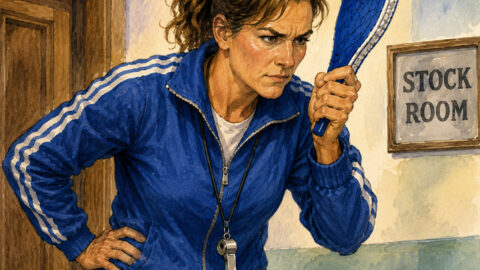
“Mr Allen, the PE master, gave me two strokes of the cane because I had forgotten my plimsolls and played badminton in the main hall wearing ordinary shoes.”