Interest in historical records concerning corporal punishment in schools has grown considerably in recent years. In earlier decades many schools maintained daily logbooks or diaries, some by official requirement and others by long-established custom. These records commonly noted attendance, visitors, special events and disciplinary matters, including corporal punishment. At that time such punishment was widely regarded as a normal and accepted means of maintaining order within schools.
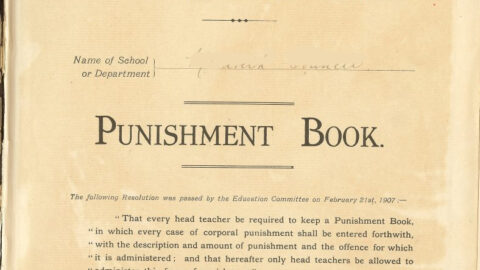
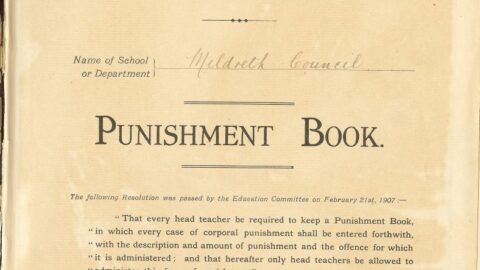
As schools increasingly came under the administration of local education authorities, greater emphasis was placed upon the formal recording of corporal punishment. Although many authorities issued general guidelines governing its use, these regulations appear to have been interpreted with considerable flexibility. The frequency and severity of punishment varied markedly from one school to another.
The format of punishment record books also differed between regions. In schools where punishment was confined to the hand, there was often little need for detailed description. It is believed that some schools, particularly girls’ schools, limited punishment to the hand alone, while many girls’ schools did not employ corporal punishment at all. In such cases misconduct was often reported directly to parents, who might then administer discipline at home.
Most punishment books appear to have included the date, the pupil’s name and sometimes the form or class. The nature of the offence was usually recorded, followed by details of the punishment itself. These details could include whether the punishment was administered to the hand or buttocks, the instrument used — such as the cane, strap or slipper — the number of strokes, and the name of the member of staff responsible.
It has often been suggested that a significant number of punishments administered informally within classrooms were never officially recorded. One former grammar school pupil recalls that his form master frequently employed corporal punishment during lessons, using a ruler, slipper and occasionally a cane. Although the punishments were painful, they were not regarded at the time as excessive. During the 1950s many parents also employed physical discipline in the home, and school punishments were often viewed as an extension of accepted domestic practice.
Formal punishment administered by a headmaster, however, was almost certainly entered into the punishment book and, in some instances, accompanied by a letter to parents. This could result in additional punishment at home. One former pupil recalled receiving a caning alongside two other boys involved in the same incident, each witnessing the punishment of the others before his own was administered.
When the possibility of reintroducing corporal punishment into schools is occasionally raised, most observers regard such a development as highly improbable. Social attitudes, educational practice and the relationship between schools, parents and young people have altered profoundly since the mid-twentieth century. Many consider these changes to have been beneficial.
During research into educational records in Hampshire, several pages from the punishment book of Alderman Quilley Secondary School in Eastleigh came to light. Although the surviving photographs are of poor quality, they nevertheless provide an illuminating glimpse into disciplinary practices of the late 1970s.
The school appears to have been co-educational, and there are references suggesting that girls may occasionally have received punishment with the slipper for offences committed in school. However, the surviving entries seem to record only boys as recipients of corporal punishment. The disciplinary regime itself does not appear particularly severe. The maximum punishment recorded was generally two strokes, sometimes specified as being administered to the hand or buttocks, though more frequently described simply as “slipper”.
One contributor examining the records observed that a teacher’s handwriting appeared to refer to the cane rather than the slipper, though the poor quality of the original photographs makes certainty difficult. Another noted a comment recalling a mother administering punishment at home with a slipper.
The cover of the punishment book itself contained several handwritten additions of a humorous nature, including references to “delinquents” and a warning that “naughty pupils will be beaten with a size 14 Dunlop slipper”. Whether this referred to a specially purchased implement or merely to the footwear of a large-footed master remains unknown.
Many surviving punishment books are difficult to decipher owing to untidy handwriting. Some have speculated that the poor script reflected embarrassment or discomfort on the part of teachers recording such punishments, though others suggest it was simply regarded as an administrative task carried out with little expectation that the records would ever be closely examined.
It is noteworthy that even relatively minor punishments, such as slippering, were formally recorded. This may suggest that little unrecorded corporal punishment occurred within the school. By the late 1970s corporal punishment had already become less common in many British schools, and staff may have exercised greater caution in administering severe penalties for fear of complaints or public criticism.
Despite the poor quality of the surviving images, the records remain of considerable historical interest, offering insight into disciplinary customs during a period of significant social and educational change in Britain.