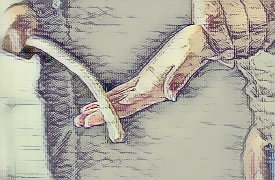
Although, as he assured his pupils, he wished to govern through trust and kindness when he began his work in 1863, Wilson nevertheless administered corporal punishment. Boys found guilty of lying or cheating were routinely caned. Evidence of his practices survives in scattered recollections, including that of T. Aylesbury Brown, who attended the school between 1889 and 1893 and recalled seeing the tawse used only once during his five years there. On that occasion, however, it was applied with considerable severity: a boy accused of impertinence towards a master received twelve strokes on each hand. Wilson, who walked with a limp, came personally to administer the punishment. The boy was afterwards sent back to his dormitory and shortly thereafter left the school for home.
A delay in discipline may well have spared Wilson a measure of embarrassment at a swimming carnival in the 1870s. On seeing severe bruising on the back and legs of a pupil, Ernest Jackson, Wilson was distressed to discover that the marks had been caused by a punishment he himself had administered with the tawse. Jackson later wrote that he bruised very easily.
By the 1920s, ideals of masculinity were strongly cultivated within the boarding houses, where prefects exercised considerable authority and frequently imposed corporal punishment. During the summer months, the effects could often be observed at the school baths, where boys, in accordance with long-standing custom, swam unclothed and at times bore visible welts and marks.
The Reverend Dr Francis Brown, serving as headmaster, inspired among students a sense of almost unquestioned authority. One former pupil remarked that boys regarded him as “almost as omnipotent as God, and nearly as distant”, except on Monday mornings, when those who had misbehaved encountered the consequences of disciplinary caning at close quarters.
Mr E. T. Williams, a housemaster remembered with affection by many pupils, was recalled by Ian Nicholson as fond of reciting his favourite poem, Drake’s Drum, in the dormitories. On one occasion, when Williams declaimed the line, “Captain, are thou sleeping there below?”, a mischievous voice from beneath a bed replied, “Aye, aye, sir.” The offender was promptly caned with six strokes. Nevertheless, Williams, who was known for tempering discipline with generosity, later sought to restore good feeling by inviting the boy to share coffee and Banbury tarts.
Sir James Darling, another notable headmaster, concluded one school occasion with characteristic wit and theatricality. After thanking the school community for their gifts, he ceremonially broke his cane and cast aside his mortar board, much to the amusement and delight of those present.
Brian Jones later reflected that the school of the 1920s, though small and highly regulated, was in many respects “outstandingly civilised”. Its relative isolation and strong house system fostered a close-knit atmosphere. He remembered the boys as generally considerate towards one another, with little evidence of severe bullying or excessive brutality. At the same time, he observed that few pupils questioned the extensive network of rules, routine punishments, corporal discipline, and detentions that governed daily life.
House captains were also empowered to administer caning. Hugh Luiggi, one of the founding members of Francis Brown House between 1937 and 1940, recalled a boy being punished for insulting the King by placing the monarch’s image upside down on an envelope. Luiggi believed that caning, though widely relied upon as the principal means of discipline, had become less effective because of its frequent use and the limited distinction between minor and major offences. He further remarked that conditions in another house, Manifold, were reputedly considerably harsher.
In Wesley College: The First Hundred Years, historians Geoffrey Blainey, James Morrissey and S. E. K. Hulme noted that references to corporal punishment were less frequent than in many comparable school histories, although such discipline remained a recognised aspect of school life. Former pupils sometimes referred to their masters as “the men who disciplined us sternly”, reflecting both the rigour and familiarity of the era’s educational culture.
The term “President”, as used in the early history of Wesley College, requires some explanation. Administrative authority was divided between the Headmaster and the President. While the Headmaster oversaw academic affairs, the President acted in effect as boarding house master and chaplain. Importantly, the President also held a seat on the School Council, a privilege not extended to the Headmaster, and could therefore exert substantial influence over school policy and administration.
The following incident from the tenure of Professor Henry Martyn Andrew as Headmaster and the Reverend James Swanston Waugh as President illustrates the disciplinary standards of the period. Early in 1876, several younger boys returning home from school were accused of throwing stones and breaking the windows of a nearby residence. Although pupils did not at that time wear school uniform, the complainant identified the boys as belonging to Wesley College and lodged a protest with President Waugh.
Waugh and Andrew conducted an inquiry and eventually uncovered the culprits after, as the account records, overcoming repeated evasions and falsehoods. The boys were required to provide money to compensate for the broken windows and were then offered a choice: to withdraw voluntarily from the school, which Andrew distinguished from formal expulsion, or to submit to corporal punishment. Several chose the latter.
Waugh approved of the decision, and Andrew himself administered the punishment. One pupil, a twelve-year-old boy named Albert Pilley, was caned with notable severity. According to later accounts, Andrew lost his temper and struck the boy approximately twenty-one times across the back and shoulders.
Pilley’s father subsequently sought both medical and legal advice concerning his son’s injuries. Within days, Andrew appeared before the Prahran Court charged with unlawful assault, an offence carrying the possibility of imprisonment.
The central issue before the court was not whether the punishment had occurred, but whether it had been administered with excessive force. Andrew retained the distinguished advocate J. L. Purves in his defence.
Testimony supporting Andrew was provided by Howell Thomas, the school’s second master who had witnessed the incident; by the Reverend Mr Waugh; by E. E. Morris, newly appointed headmaster of Melbourne Grammar School; by Professor Irving of Hawthorn Grammar School; and by a medical practitioner. Irving informed the court that during his own tenure he had maintained a policy of flogging boys for persistent dishonesty and had commonly punished one boy each week in this manner, which by the standards of the period was considered comparatively lenient. Andrew himself argued that disciplinary action had been necessary in order to prevent the boys from facing prosecution before the ordinary courts.