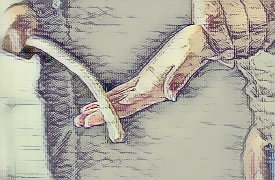
At our school, corporal punishment was a visible and accepted part of everyday life. It existed within the wider culture of the school rather than as something hidden away, and students developed their own attitudes and rituals around it.
Boys were permitted to walk through the school quadrangle, but they were not allowed to stop or linger there. Despite this restriction, students were naturally curious about disciplinary matters. The principal’s office occupied a prominent position, and its location made it difficult to ignore what was happening there. Opposite the office stood the library staircase, which provided a convenient excuse for passing by. Students heading to or from the library could easily glance towards the office and see who was waiting outside.
As a result, the area often became a focal point for curiosity. Those waiting to be disciplined were keenly observed by other students, and particular attention was paid to the demeanour of those emerging from the principal’s office. Some came out trying to appear unaffected, while others looked embarrassed, angry, or relieved that the ordeal was over. Observing these reactions became part of the unspoken social life of the school.
Contrary to what some people might assume, I never witnessed girls showing any obvious or overt fascination with canings. Nor did I ever hear girls openly questioning boys about their experiences. That does not mean such conversations never occurred. It is likely that questions were asked privately among friends or in more discreet settings, away from the public gaze of the schoolyard.
Within the student community, receiving corporal punishment carried a certain social significance. There was often a perception that a student who had faced the cane had demonstrated a degree of courage by enduring it. Consequently, a limited amount of status could be attached to having been punished. However, this status had its limits. A student who received the cane occasionally might be regarded as tough or resilient, but someone who was repeatedly punished risked being viewed as foolish, irresponsible, or incapable of learning from their mistakes. There was a fine and often uncertain line between being considered brave and being regarded as simply troublesome.
For some girls, receiving the cane or the slipper also carried symbolic meaning. In a school where both sexes were subject to the same disciplinary measures, corporal punishment could be seen as evidence that girls were being treated on equal terms with boys. Some students, both male and female, regarded their first experience of corporal punishment almost as a rite of passage. When a student received the cane or slipper for the first time, friends would sometimes jokingly welcome them to “the club,” acknowledging that they had joined a shared experience familiar to many of their peers.
Attitudes towards corporal punishment varied considerably from one school environment to another. In schools where only boys were subjected to corporal punishment, the situation appears to have been different. From conversations I have had with women who attended such schools, I learned that opinions varied widely. Some girls viewed boys who had been caned as tougher, more rebellious, or more masculine. Others saw them as failures who had simply gotten themselves into trouble. There was no single, universal reaction.
Speaking from my own experience, however, I never judged people according to their disciplinary record. Corporal punishment was simply one aspect of school life. It happened, and students accepted it as part of the environment in which they lived and learned. Whether a boy had been caned or not had little bearing on how I viewed him as a person.
What mattered far more was character. Personality, kindness, humour, confidence, and the way someone treated others were infinitely more important than whether they had ever been sent to the principal’s office. There were boys who frequently found themselves in trouble whom I liked very much and considered good friends. Equally, there were others with spotless disciplinary records whom I preferred to avoid. A clean punishment record was no guarantee of good character, just as receiving the cane was no indication that someone was a bad person.
Looking back, corporal punishment did not make students inherently more attractive, more admirable, or more undesirable in the eyes of their peers. It was simply an experience that some students went through and others avoided. Ultimately, the qualities that shaped friendships and relationships were the same as they have always been: personality, behaviour, and the way people treated those around them.