For many thirteen-year-olds, the initial shock of receiving a school caning may soon have given way to a sense of having passed a rite of passage. Once the anticipation and anxiety had been endured, some boys perhaps felt less concerned about facing the punishment again—at least until the moment came to bend over for another caning.
One former recipient recalled how, after receiving his punishment, the administrator quietly informed him that the cane used was the type generally considered suitable for younger secondary-school pupils. This left him wondering what older boys experienced when subjected to heavier canes and more severe punishments.
Another individual described receiving four strokes with a rattan cane at the age of fifteen. He remembered the pain as being highly concentrated at the point of impact before radiating outward. In his view, the discomfort lasted longer than that caused by a belt. While painful, he considered it comparable to other forms of corporal punishment used at the time.
A detailed account described a traditional school-style caning administered in a bent-over position, with the recipient grasping his lower legs while keeping his feet apart. Considerable attention was paid to positioning so that the strokes could be delivered accurately and evenly. Although uncomfortable, the arrangement allowed him to see what was happening throughout the punishment.
The physical effects were significant. Dark pink, raised stripes appeared immediately afterwards, with one mark seemingly breaking the skin. The intense stinging sensation subsided relatively quickly, but tenderness remained for several days. Some marks developed into faint bruises before gradually fading. Five days later, visible lines remained, though the soreness had disappeared.
Such descriptions naturally raise the question of how closely a modern recreation can mirror historical reality. The answer is complicated because there was no single, standard school caning experience.
Corporal punishment varied enormously depending on the school, the individual administering it, the type of cane used, and the circumstances surrounding the offence. Some canings were relatively mild, while others were remembered as intensely painful. Most fell somewhere between these extremes.
The cane itself played a major role. A lighter junior cane could still produce considerable pain and leave lasting marks, especially when several strokes were administered. Heavier senior canes, however, were capable of delivering a far more severe punishment. Recipients often recalled feeling their legs weaken, their heads swim with pain, and their movements become noticeably impaired afterwards.
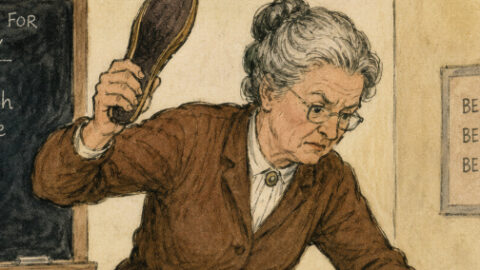
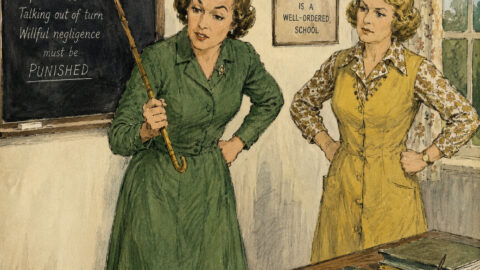
Former pupils frequently emphasised that, regardless of later reflections, corporal punishment was not something they welcomed at the time. Most would have done almost anything to avoid receiving it. One man who attended several schools remembered being caned only by male senior staff, while female teachers typically used a slipper. He noted that the punishments were genuinely feared and were never regarded as pleasant experiences.
Another former pupil recalled attending a boarding school during the 1960s. The school operated a system of pluses and minuses, with four minuses in a week resulting automatically in a visit to the headmaster. At eleven years old, he found himself waiting outside the headmaster’s study alongside several other boys. Hearing the swish of the cane and the impact of each stroke on the boy before him only increased his anxiety.
When his turn came, he was lectured about his behaviour before being instructed to bend over and touch his toes. Four strokes followed. Although the pain was intense, he managed not to cry. The headmaster warned him that a second appearance would result in six strokes—a threat that was later carried out. Like many others, he remembered the punishment as excruciating at first but fading into a lingering stinging sensation.
Memories such as these highlight the challenge of accurately recreating historical corporal punishment. The physical pain was only one part of the experience. Anticipation, fear, embarrassment, and the authority of the person administering the punishment all contributed to its impact. Reproducing those emotional factors later in life may be far more difficult than replicating the physical sensations alone.
Questions also arise regarding the reliability of personal accounts. Some recollections are undoubtedly accurate, while others may be exaggerated, embellished, or influenced by the passage of time. Details such as clothing, conversations, and exact circumstances can become blurred or unconsciously reconstructed. Without independent verification, it is often impossible to determine precisely where memory ends and imagination begins.
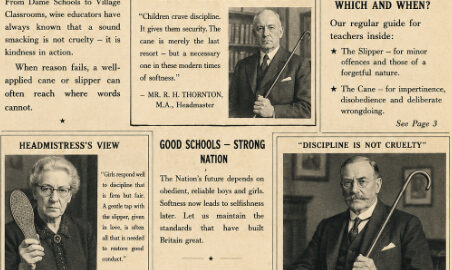
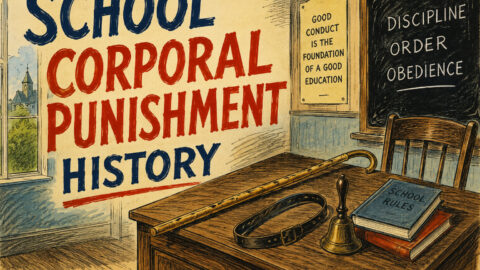
What is certain is that corporal punishment was a reality for millions of pupils during much of the twentieth century. Boys and girls alike attended schools where caning, slippering, paddling, or other forms of physical discipline were accepted parts of school life. While attitudes towards such practices have changed dramatically, memories of them remain vivid for many who experienced them.
Today, opinions about school corporal punishment vary widely. Some regard it simply as an unpleasant aspect of their education, remembered with a degree of humour or nostalgia. Others view it as an outdated disciplinary method that deserved abolition. Whatever the perspective, these recollections offer valuable insight into a form of school discipline that was once commonplace but has now largely disappeared from educational life.