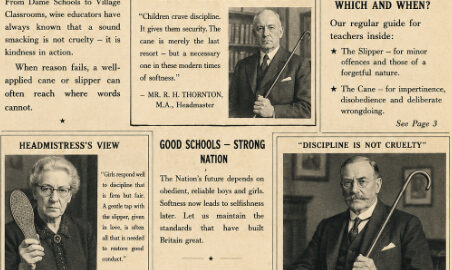
He justified the severity of the punishment by recalling the advice given to him by Irving upon the latter’s resignation as headmaster: “Andrew, do not administer punishment hastily; but when punishment is necessary, administer it thoroughly, so that it need not be repeated.” The court, however, took a dim view both of this counsel and of Andrew’s vigorous interpretation of it, and imposed a fine of five pounds.
Yet Andrew emerged from the courthouse not as a disgraced figure, but as a public champion. In an editorial published on 25 February 1876, The Argus condemned the court’s decision. The newspaper argued that corporal punishment was “even more necessary here than in the mother country, because domestic restraints are so much weaker in Victoria, and the physical and mental development of the young proceeds much more rapidly.” Numerous letters subsequently appeared in the paper, the majority expressing support for Andrew.
Fathers of large families praised him as a guardian of youthful morality and as the undeserving target of “the sneers of evil-doers.” Contributions towards his legal expenses arrived in substantial numbers at the newspaper office. One supporter reported that he had collected a shilling each from seventy men within a matter of minutes beneath the verandahs of Collins Street, then a customary gathering place for merchants and speculators. Further endorsement came in the form of a signed address from approximately sixty schoolmasters and educationalists, who conveyed their sincere sympathy and approval.
Professor H. M. Andrew undoubtedly enhanced his standing among stern and traditional parents, many of whom had previously regarded him as somewhat young and inexperienced.
Lawrence Arthur Adamson, widely regarded as one of Australia’s greatest headmasters, extolled the virtues of good conduct and deportment, and public opinion soon aligned itself with his views. One story frequently repeated concerned a boy appearing before him for a first offence. The boy declined the opportunity to avoid corporal punishment by pleading his previous good record. Adamson reportedly approved highly of this willingness to accept responsibility and commended the pupil accordingly. “Could anyone fail to admire such a boy?” a contemporary scholar later remarked.
Another anecdote concerned a senior boy who deliberately passed through a doorway reserved for prefects. Despite the boy’s senior standing, Adamson administered punishment. The boy later acknowledged that the headmaster had acted correctly. Once again, there was widespread approval that improper conduct had received appropriate correction.
Junior boarders were relieved to discover that discipline in the senior house was less severe than that to which they had previously been accustomed, although by ordinary standards it remained notably strict. Official discipline was maintained through written exercises and corporal punishment. Responsibility for administering such punishment rested solely with the housemaster.
Geelong College, distinct from Geelong Grammar School, was frequently confused with its larger and more prestigious counterpart. Indeed, it was sometimes alleged that the College benefited from this confusion in attracting pupils. Geelong Grammar enjoyed greater social prestige during the late nineteenth century and again during the 1960s and 1970s, particularly after Charles III, then Prince Charles, attended the Grammar for two terms, although the College often achieved stronger academic results.
Historically, Geelong College was the smallest among Victoria’s leading schools and was the last to be admitted to that distinguished grouping, in 1908.
The available historical record, dating from 1961, contains relatively little material concerning corporal punishment. Nevertheless, several observations remain of interest. The source is The Geelong College: 1861–1961 by G. C. Notman and B. R. Keith.
Dr George Morrison, headmaster, had served as President of the Debating Society at the university, where he acquired the eloquence that later rendered his moral addresses to offending pupils particularly formidable. Many boys reportedly preferred his comparatively mild canings to his lengthy and impressive lectures.
His son, Mr Charles Norman Morrison, also headmaster, was at the same time a strict disciplinarian. It was an era in which corporal punishment was widely accepted as a normal aspect of school discipline by both masters and pupils alike.
Mr A. H. MacRoberts, Vice-Principal, returned from military service to assume his position at the College. Formerly a history master, cricket master, and editor of The Pegasus, he transformed himself from a quiet and almost jovial figure into the stern authority demanded by circumstances. In disciplinary matters, his approach complemented that of Mr Rolland. To some extent, he represented the iron hand within the velvet glove.
While the Principal concerned himself with matters of finance, architecture, and public relations, Mr MacRoberts devoted his attention to the maintenance of internal order. His weekly inspection of boys’ records inspired considerable apprehension, even among the more courageous pupils. As chief disciplinarian, he became particularly noted for detecting attempts by boys to lessen the effects of corporal punishment through the wearing of additional undergarments.
The difficulty he experienced in relaxing these stern standards, even after conditions improved, may be regarded as evidence of the sacrifices he believed necessary in preserving the authority of the College during challenging times. Until the end of his service, he retained a deep affection for cricket, and boys who distinguished themselves in Public School matches might occasionally be summoned to the bookroom not for punishment, but to receive a ten-shilling note in recognition of their achievement. Mr MacRoberts remained Vice-Principal until 1938.